| Theories and Techniques of Oral Implantology (vol.2) (published 1970) | Dr. Leonard I. Linkow |
 Previous Page Previous Page
|
Next Page 
|
| This is an archival HTML version of this book originally hosted here in 2006. The HTML may not display well on modern browsers. Please view the modern PDF Version for a better viewing experience. |
CHAPTER 15 Atypical implant situations
Today most partially or completely edentulous patients can be helped by one or a combination of several endosseous techniques. Linkow has been able to perform at least one type of implant intervention on from 80% to 95% of his presenting patients, enabling them to avoid removable prostheses.
The following cases are unusual; most patients do not have such debilities nor is insertion of the implant normally so difficult. Yet the results of endosseous procedures on these patients seem to premise their wider use in atypical situations. Masticatory function has been restored by various endosseous techniques to patients suffering from congenital deformities such as cleft palate, severe malocclusion, and deformities caused by traumatic in-jury or diseases. The temporary use of endosseous implants in prosthodontics has also been successful.
Case 1
A full mouth restoration for a patient with a cleft palate
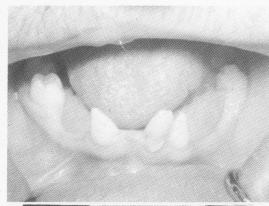
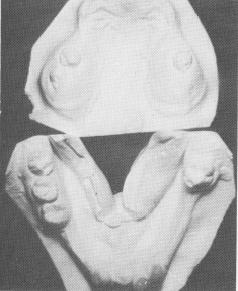
The patient, a 17-year-old boy, was depressed and despondent because of his cleft palate and hare lip. His remaining mandibular teeth were three right atypically shaped molars, a left second molar, and three anterior peg-shaped incisors that were severely malpositioned (Fig. 15-1). His upper teeth on the left side consisted of an atypically peg-shaped second bicuspid and two tapered molars, and on the right side a tapered second bicuspid and a molar (Fig. 15-2). The patient had been wearing a full upper acrylic denture with holes in it corresponding to the remaining molar teeth (Fig. 15-3).
The mandibular teeth were prepared for full crown coverage. Compound tube impressions, a wax interocclusal record of centric relation, and other necessary records were taken. On the second visit platinum copings were fitted over the lower teeth
(Fig. 15-4), and once again a wax interocclusal record of centric relation was taken. A plaster index of the entire lower arch was made, picking up the copings (Fig. 15-5). From this, the final full arch, porcelain-fused-to-metal prosthesis was fabricated (Fig. 15-6). This was cemented into place (Fig. 15-7).
The remaining maxillary teeth were then pre-pared for full crown coverage. Plastic copings were fabricated with a bite block (Fig. 15-8). The copings were placed in the patient's mouth, and a bite registration and a plaster index were made. The models were articulated and metal copings cast (Fig. 15-9).
Fig. 15-1. A, The lower teeth were peg-shaped and flared out from one another. B, Maxillary and mandibular study casts. No teeth existed in the maxilla anterior to the atypically shaped molars on each side.
A
B
|
Previous Page
|
Page 629 |
Next Page
|
|
Copyright warning: This information is presented here for free for anyone to study online. We own exclusive internet copyrights on all content presented on this website. We use sophisticated technology to identify and legally close down websites that reproduce copyrighted content without permission - so please don’t do it.
|