| Theories and Techniques of Oral Implantology (vol.2) (published 1970) | Dr. Leonard I. Linkow |
 Previous Page Previous Page
|
Next Page 
|
| This is an archival HTML version of this book originally hosted here in 2006. The HTML may not display well on modern browsers. Please view the modern PDF Version for a better viewing experience. |
628 Theories and techniques of oral implantology
A
B
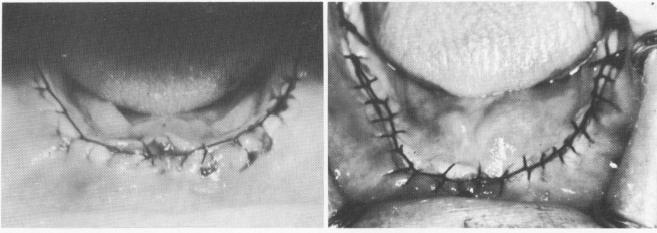
Fig. 14-47. A, Suturing must be done carefully to cover the underlying bone completely. Interrupted sutures or a combination of interrupted and mattress sutures are usually indicated. B, Sometimes continuous suturing is preferred. However, enough sutures should always be used so that no open spaces exist between the incised tissues.
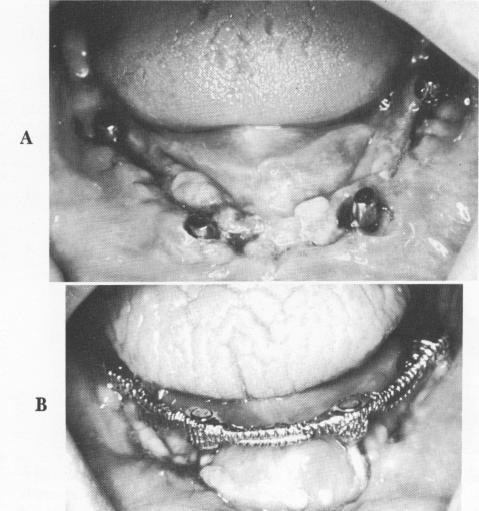
Fig. 14-48. A, Severe inflammation of the fibromucosal tissue, which was "squeezed" between the implant's sub-structure and the denture. B, The anterior struts of the substructure have become exposed. Such a situation can rarely be compensated.
the periosteum will result in excessive bone resorption and the bone's healing by secondary intention.
Incomplete healing. At least 3 to 6 weeks should be allowed for the healing of the soft tissues before inserting the implant. (If, however, the implantation is done as a 1-day procedure, this is not neces-
sary.) By waiting this period of time, the tissues should have healed completely and be fairly elastic. Thus when they are stretched and sutured over the implant, they will not tear. Any tearing would ex-pose the substructure of the implant, leading to eventual failure.
Poor suturing techniques. Suturing must be done carefully to avoid stretching and tearing the tissues (Fig. 14-46). As many sutures as are necessary to completely cover the bone should be used. Not even a minute amount of bone should be left exposed. The sutures—whether they be interrupted, mattress, or continuous—should be neat, close together, and accomplished with a fine silk suture (Fig. 14-47).
Poor occlusion. Undue stress on the prosthesis will be transmitted to the implant. The consequences will cause the implant to fail.
Improper stress distribution. The denture should rest on the posts, not on soft tissues. Otherwise the denture will compress the tissues between it and the underlying substructure of the implant, causing inflammation and irritation (Fig. 14-48). The tissue may also be rubbed away from one of the under-lying struts, leaving it exposed and creating a path-way for infection.
As can be seen with all types of implantsendosseous or subperiosteal the failures were largely caused by errors in patient evaluation, choice of implant, or operative technique. Clinical experience will teach the reasons why one type of implant will fail and another type will succeed. Experience, together with continual careful evaluation and good craftsmanship, will radically reduce the number of failures.
|
Previous Page
|
Page 628 |
Next Page
|
|
Copyright warning: This information is presented here for free for anyone to study online. We own exclusive internet copyrights on all content presented on this website. We use sophisticated technology to identify and legally close down websites that reproduce copyrighted content without permission - so please don’t do it.
|