| Theories and Techniques of Oral Implantology (vol.2) (published 1970) | Dr. Leonard I. Linkow |
 Previous Page Previous Page
|
Next Page 
|
| This is an archival HTML version of this book originally hosted here in 2006. The HTML may not display well on modern browsers. Please view the modern PDF Version for a better viewing experience. |
Causes of implant failure 625
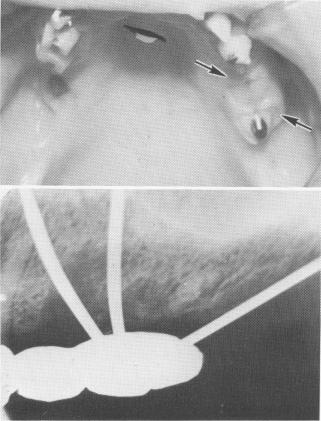
Fig. 14-38. A, The soft tissue directly surrounding the blade implant is compressed (arrows) because of poor pontic relationship. The tissues can become mutilated and inflamed if this is not alleviated. B, Triplants were forced through improperly sized and directed holes in the template (the holes were too small). This caused a torque action on the template and on the pins themselves (notice how pins are curved in bone), which led to bone destruction.
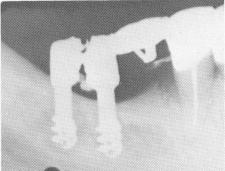
Fig. 14-39. A broken solder joint can lead to an increased load and stress on the isolated implant leading to bone resorption. The solder joint could have also broken because of a poorly fitted bridge that caused excess stress on the solder joints as well as on the implants themselves.
A
B
to be comfortable, it may be seated with oxyphosphate of zinc cement.
Poorly fitting permanent splints. A permanent splint must fit passively over the implants or else it will act as an orthodontic appliance. To ensure a passive fit, the protruding implant posts and abutments should be parallel and the impressions made of them extremely accurate. Tension or pressure between the abutments of a fixed denture can cause excessive strain on both the implant and the prosthesis (Fig. 14-39).
Misuse of modeling compound copper tube impressions. Copper tube impression compound should never be used in taking an impression of an acrylic core over a triplant or over a blade implant. Re-moving such an impression can sometimes dislodge the implant. Any one of the elastic impression materials is preferable for such purposes. However, compound impressions can be used without coolants. To eliminate "drag," the impression is removed and re-placed over the implant post a few times. When it is removed the last time it is placed in cold water.
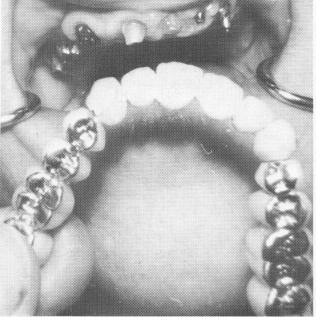
Poor crown preparation. If the length and degree of taper of a crown are not carefully shaped, the crown may be of little value as an abutment (Fig. 14-40). The supposedly permanent cement
Fig. 14-40. Poorly prepared teeth—such as short teeth used without adequate steps to lengthen their clinical crowns with well-fitted telescopic copings or pin-ledge type of restorations—can lead to loosening of the bridge, with eventual loosening of the implants.
seal may break, leaving the still-sealed implants to bear alone the stresses upon the bridge. Such undue pressure will cause implant failure.
Improper use of cement. Temporary cement should not be used for the final cementation of the completed prosthesis. Because the abutment teeth have usually been tapered and their line angles eliminated, temporary cement can easily wash away between the crown and the tooth. Temporary cement inside the crown covering the square-shafted, untapered implant is far less likely to wash away. As a result, not only is undue strain placed on the still cemented implants, but tooth decay eventually occurs inside the empty crowns (Fig. 14-41). Again, if the implants have been cemented to the prosthesis, there is a good chance of loosening them while re-moving the bridge to repair the broken cement seals. Therefore all fixed dentures should be sealed to the implants and teeth with oxyphosphate of zinc cement, which should be trimmed to avoid irritation
|
Previous Page
|
Page 625 |
Next Page
|
|
Copyright warning: This information is presented here for free for anyone to study online. We own exclusive internet copyrights on all content presented on this website. We use sophisticated technology to identify and legally close down websites that reproduce copyrighted content without permission - so please don’t do it.
|