| Theories and Techniques of Oral Implantology (vol.2) (published 1970) | Dr. Leonard I. Linkow |
 Previous Page Previous Page
|
Next Page 
|
| This is an archival HTML version of this book originally hosted here in 2006. The HTML may not display well on modern browsers. Please view the modern PDF Version for a better viewing experience. |
626 Theories and techniques of oral implantology
(Fig. 14-42). It should be noted that Linkow now prefers the carboxylate cements.
Failure to immobilize implants when using a re-movable prosthesis. If a removable prosthesis is de-sired either by the dentist or the patient, some pro-vision must be made to keep its movements from eventually loosening the implants and remaining teeth. The typical removable appliance derives some of its retention from its soft tissue adaptation. Be-cause of this it rides up and down over the fibromucosa. If a mesostructure splint consisting of copings soldered together by a dolder bar is not prepared to connect all the implants and remaining teeth, the movements of the removable appliance as it rides up and down will eventually dislodge the implants. Therefore a removable prosthesis should be fabricated over a mesostructure.
In planning such an appliance for an edentulous mandible, usually post type implants or blade-vents secured with a full arch, fixed mesostructure are all that is necessary.
Poor choice of prosthesis material. In planning
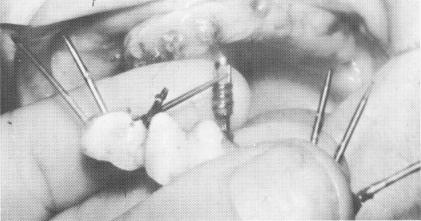
Fig. 14-41. Cavities developing underneath crowns that support fixed dentures also lead to eventual loss of the bridge as a result of cement seal leakage that loosens the prosthesis, thereby increasing the load on the implants and resulting in their eventual mobility. Here are seen two triplants and a vent-plant pulled out of the mouth still attached to the bridge.
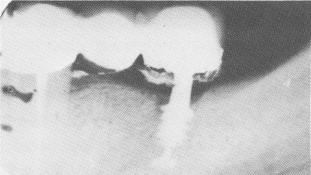
Fig. 14-42. Any hard cement left underneath crowns covering implants can cause irritation of the soft tissue, which can lead to bone resorption.
a full arch prosthesis for an edentulous maxilla, a porcelain-fused-to-metal prosthesis should never be used. This type of appliance is very heavy, and the effect of gravity on a maxillary prosthesis should be considered. For a full arch maxillary restoration, an all-acrylic splint, an acrylic-built-over-gold splint, or an all-acrylic palateless type denture are suitable. Very recently, a new metal formula for the fusion of porcelain to it has been developed. Platinum is replaced with palladium mixed with gold, resulting in an extremely lightweight prosthesis.
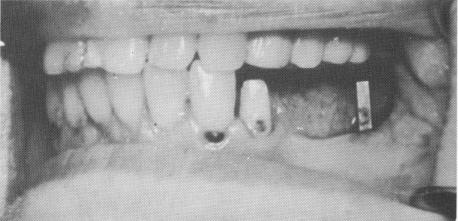
Poor occlusion. One of the most important considerations in the long-term security of implants is proper occlusion (Fig. 14-43). Occlusal disharmony can cause the implants to loosen by increasing the shock of premature or interfering contacts on the implants. It is vitally important to take accurate impressions for both temporary and final splints. These splints must be carefully fabricated, inserted, occluded, and balanced.
REASONS FOR SUBPERIOSTEAL IMPLANT FAILURES
A subperiosteal implant may fail for anatomic, s stemic, or operative reasons. These include:
Poor choice of site. Subperiosteal implants are indicated only for a mandible where sufficient alveolar bone resorption has occurred. Otherwise, as the bone resorbs, the implant will fit inaccurately and move, causing complications (Fig. 14-44).
Inaccurate impression of site. To get a true impression of the bone's landscape, the site must be surgically exposed. When planning a full mandibular restoration, the impression must include the external oblique ridges, mylohyoid ridge, symphysis, genial
Fig. 14-43. Poor judgment in restorative procedures could lead to failure. The upper bridge should have first been constructed longer so that the torque action would be de-creased on the lower implant, which would then have been made shorter. The bridge should also have been fabricated with shorter clinical crowns.
|
Previous Page
|
Page 626 |
Next Page
|
|
Copyright warning: This information is presented here for free for anyone to study online. We own exclusive internet copyrights on all content presented on this website. We use sophisticated technology to identify and legally close down websites that reproduce copyrighted content without permission - so please don’t do it.
|