| Theories and Techniques of Oral Implantology (vol.2) (published 1970) | Dr. Leonard I. Linkow |
 Previous Page Previous Page
|
Next Page 
|
| This is an archival HTML version of this book originally hosted here in 2006. The HTML may not display well on modern browsers. Please view the modern PDF Version for a better viewing experience. |
Causes of implant failure 623
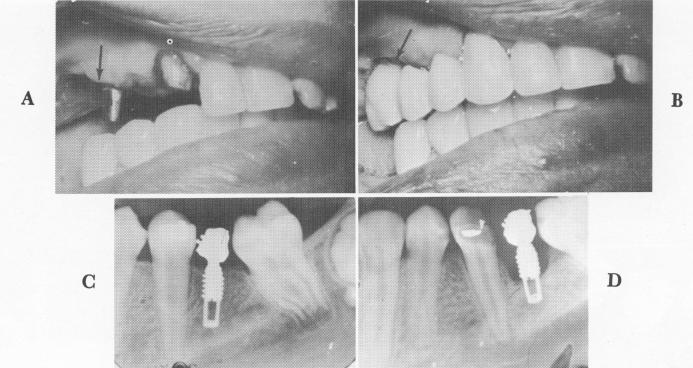
Fig. 14-33. A and B, Using a blade with an extra long neck is frequently preferable to cutting away a good portion of the tissue. Here the processed fixed partial denture had to be fitted to the atypical and irregular gum line because of the tissue removal. Arrows point to areas where the fibromucosal tissue was excessively removed, resulting in overlengthening of the molar crowns. C, Immediate postoperative x-ray shows bone around an unsupported single tooth implant. D, The bone damage is evident 12 months later around the unsupported vent-plant. Also, this was an earlier designed implant, which also contributed to its failure.
tive procedure, the result may be immediately evident or develop over a period of weeks. The following considerations are common prosthodontic causes of implant failure.
Unsupported implants. Normal movements of the tongue, cheeks, and lips are enough to dislodge an implant with a protruding post. Immediate splinting protects the protruding post and also protects the soft parts of the mouth from the post's sharp edges. Although the internally-threaded vent-plant and Muratori's internally-threaded spiral screw implant do not protrude as far into the mouth as a nonthreaded implant, it is advisable to use a splint to ensure immobility.
Single tooth implants unsupported by neighboring teeth will fail (Fig. 14-34). They must be immediately stabilized by a splint or the implant can move and prevent healing. No matter what type of implant is used, a temporary splint is needed unless a permanent one has been prepared beforehand.
Cementing implants to the temporary splint. In securing a temporary splint to either natural or implant abutments, no cement of any sort should ever be used inside the crowns that will cover the implants. Because the protruding shafts of the implants are square with no taper, it is difficult to remove a temporary splint without dislodging the implants unless some provision to ease removal has been made. For this reason, the protruding shafts are
covered with gold copings. These are cold cured with acrylic resin into lumens in the splint. The lumens should be slightly larger than the copings so that no interference can occur in seating the temporary splint over the copings. When securing the splint, the gold copings should be lubricated with Vaseline. The crowns that will fit over the natural tooth abutments can be filled with a temporary cement. However, care should be taken; if any cement slips around the implants and sets there, the strain exerted on the implants during splint removal may loosen them or pull them out (Fig. 14-35).
If difficulty is encountered in removing a temporary splint, those portions over the implants should be severed with rotary disks so that the splint can be easily removed without disturbing the implants.
Prolonged seating of a temporary splint. A temporary acrylic splint should not be seated too long because it tends to change in dimension. The resulting unbalanced splint may pull on the implants and dislodge them. Also, the temporary cement used to secure the splint may give way, causing the splint to loosen and move the implants (Fig. 14-36).
As soon as possible a permanent prosthesis should be set over the abutments to permanently stabilize them. As the operator becomes more experienced, the temporary splint stage can be avoided. Instead a prefabricated fixed denture, properly occluded and balanced, can be cemented over the implant
|
Previous Page
|
Page 623 |
Next Page
|
|
Copyright warning: This information is presented here for free for anyone to study online. We own exclusive internet copyrights on all content presented on this website. We use sophisticated technology to identify and legally close down websites that reproduce copyrighted content without permission - so please don’t do it.
|