| Theories and Techniques of Oral Implantology (vol.2) (published 1970) | Dr. Leonard I. Linkow |
 Previous Page Previous Page
|
Next Page 
|
| This is an archival HTML version of this book originally hosted here in 2006. The HTML may not display well on modern browsers. Please view the modern PDF Version for a better viewing experience. |
622 Theories and techniques of oral implantology
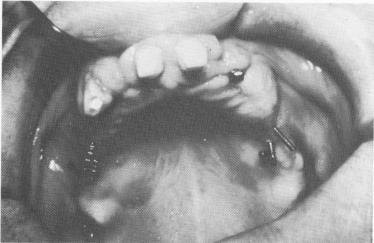
Fig. 14-30. When other teeth as well as other post type implants are used as abutments for the support of a full arch fixed denture, the longevity of triplants used without a template is increased. However, success is more assured with a template.
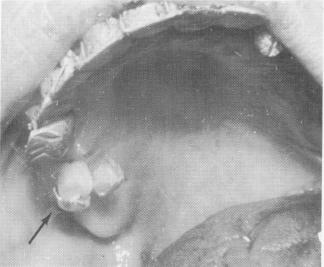
trapped inside the acrylic core. This weakens it, and it may crack or the pins may loosen inside the core. The core should be built by starting at the most gingival portion of the pins and gradually building up in an occlusal direction until the ends of the pins, which were previously notched with a fissure bur for added retention, are completely encapsulated with the acrylic core. In this way no bubbles should be included in the core. This is the most successful method known so far (Fig. 14-31).
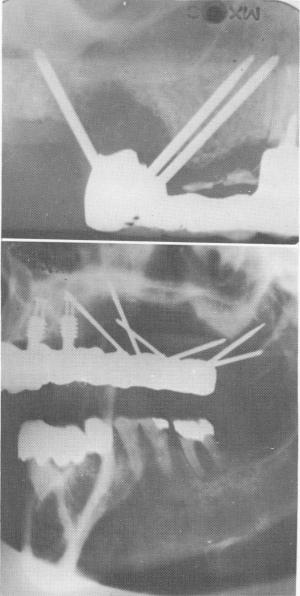
Excessively thick fibromucosa. In those cases where the fibromucosal tissue in the maxillary molar and tuberosity areas is very flabby or mobile or is as much as 6 to 7 mm. thick, it may have to be re-moved. Before deciding, the operator should deter-mine the type of implant to be used. If triplants and a stress-distributing template are to be used, the tissue should be removed at least 2 to 3 months prior to the implant intervention. Otherwise, the template will not be anchored to firm, immovable tissue and it can move up and down, loosening the implants through improper support (Fig. 14-32) .
If using a spiral-post implant, vent-plant, or blade-vent, provision may be made for excessively thick tissue by using post implants or blade-vents with extra long necks. This will prevent their occlusal ends from being completely buried in the tissue and is often preferable to cutting away the excess tissue (Fig. 14-33) . If excess tissue is to be removed, only the submucosal tissue is scooped out, leaving the mucosa intact.
Prosthodontic considerations
Included in this section are the prosthodontic procedures applicable to implantology. Most opera-
Fig. 14-31. An aluminum shell previously filled with cold cure acrylic and placed over the ends of the pins was disked open after the acrylic hardened. However, the core (arrow) fabricated in this method might contain air bubbles. There-fore it is necessary to always build the core with the brush-on technique.
Fig. 14-32. The triplants in these two cases are failing as a result of excessively thick fibromucosal tissue that restricted the depth of the pins into the bone.
tors are familiar with these procedures or variations of them as they are used in other aspects of dentistry. Their role in the success or failure of an implant intervention is obvious in most cases. If a miscalculation occurs in any prosthodontic phase of the opera-
|
Previous Page
|
Page 622 |
Next Page
|
|
Copyright warning: This information is presented here for free for anyone to study online. We own exclusive internet copyrights on all content presented on this website. We use sophisticated technology to identify and legally close down websites that reproduce copyrighted content without permission - so please don’t do it.
|