| Theories and Techniques of Oral Implantology (vol.2) (published 1970) | Dr. Leonard I. Linkow |
 Previous Page Previous Page
|
Next Page 
|
| This is an archival HTML version of this book originally hosted here in 2006. The HTML may not display well on modern browsers. Please view the modern PDF Version for a better viewing experience. |
Causes of implant failure 621
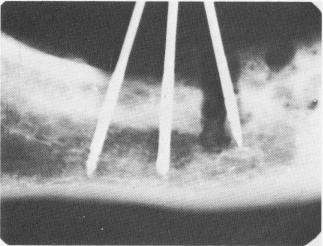
Fig. 14-27. The bone around the mesial pin now revealed the true picture.
edentulous spans or in totally edentulous jaws should be stabilized by a thin metal plate set directly over the bone, wherever possible.
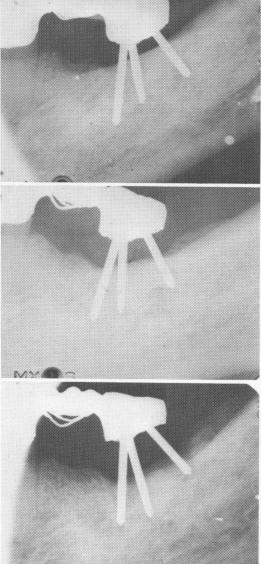
Using the old operative method, each and every triplant exhibits what in a natural tooth would be considered to be a trifurcation involvement concerning the fibromucosal tissue lying between the bony alveolar crest and the tissue-bearing surface of the acrylic core. As the fibromucosa moves during normal activities of the jaw, it tugs on the emerging triplant pins. As a result, they move and cause bone resorption (Fig. 14-28).
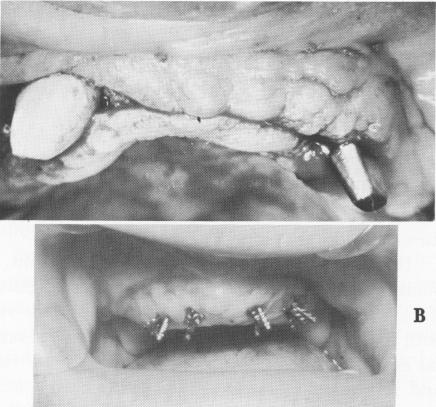
Triplants may be stabilized in such a way as to eliminate potential soft tissue trifurcation involvement. This can be done by incising and retracting the tissue over the site and by driving the pin implants directly through a thin metal plate adapted over the bone. The pins are then fused together right over the plate (Fig. 14-29) . The incised tissues are sutured around the protruding acrylic core.
In addition to the thin metal plate fitted over the bone with each triplant, a template should be placed over the fibromucosal tissue to act as a stress-distributing bar. Together, these should complement one another and resolve the movement problems that encourage bone resorption (Fig. 14-30).
When a triplant is anticipated in an edentulous area between natural teeth, neither the plate nor a template is necessary if the implant is secured to the teeth on either side with a fixed splint.
In long edentulous spans or in the totally edentulous jaw, the addition of a fourth pin making the triplant actually a quadraplant has been found helpful. The problem here is that all the legs should diverge. If this is difficult with a triplant, it is even harder with a quadraplant.
Improper acrylic fusion of triplant pins. Unless the acrylic used to fuse the triplant pins together is brushed on layer by layer, air bubbles may be
Fig. 14-28. Three serial radiographs show the steady bone resorption around a mandibular triplant.
Fig. 14-29. A, The acrylic core was built over a thin metal plate adapted to the bone. The core included the triplant pins, which were driven through the plate. B, In a completely edentulous maxilla, placing pin implants directly through the fibromucosal tissue and into the bone without the use of a metal rigid template could easily lead to failure.
A
|
Previous Page
|
Page 621 |
Next Page
|
|
Copyright warning: This information is presented here for free for anyone to study online. We own exclusive internet copyrights on all content presented on this website. We use sophisticated technology to identify and legally close down websites that reproduce copyrighted content without permission - so please don’t do it.
|