| Theories and Techniques of Oral Implantology (vol.2) (published 1970) | Dr. Leonard I. Linkow |
 Previous Page Previous Page
|
Next Page 
|
| This is an archival HTML version of this book originally hosted here in 2006. The HTML may not display well on modern browsers. Please view the modern PDF Version for a better viewing experience. |
614 Theories and techniques of oral implantology
Fig. 14-10. A broken narrow ridge implant is seen leaning toward the neighboring tooth. Broken pieces of implants, although not usually the cause of any problems, should be removed at the same time breakage happens.
on hand enough of each sized bur and tap so that he can constantly interchange them. This is particularly wise when working on patients with excessively dense mandibles, a not uncommon characteristic. Tools should be sharpened as often as necessary to avoid friction-induced heat damage.
As a further safeguard against burning, water spray attachments should always be used, even with the sharpest rotary instruments. Also recommended is that a dental assistant use an independent water spray to doubly ensure adequate coolness.
OPERATIVE PROCEDURES
Most of the mistakes leading to failure in per-forming an implant intervention occur during the operative procedures. The operative procedures can be divided into two major groups, surgical and prosthodontic. Although these procedures vary according to the type of implant used, some general rules prevail.
Surgical procedures
Surgical procedures deal with making a site for the implant and inserting it. Each type of implant has its own particular method of insertion, and undoubtedly some implants are easier to use than others. Ease and simplicity of insertion, of course, produce fewer complications. However, the choice of an implant is dictated by the suitability of its design, as well as by its method of insertion.
Although generally applicable to all implants, the following problems commonly encountered during surgery may be more significant in dealing with
Fig. 14-11. The upper left implant perforated the labial plate of bone (arrow) during its insertion without the dentist being aware of it. A 6-month postoperative cross-sectional radiograph reveals the great amount of bone resorption caused by the perforation.
one kind of implant than another. For this reason recommendations for the proper use of the implant or alternative approaches are included in the discussion.
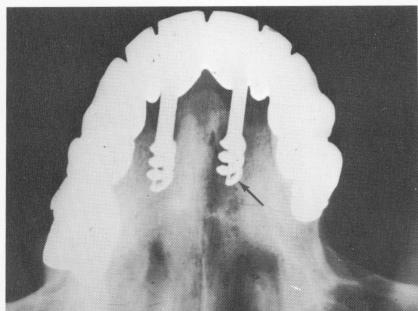
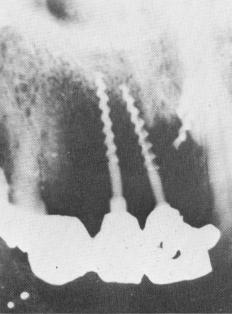
Overdrilling. Careless or overenthusiastic drilling with burs or taps can lead to perforation of the buccal, labial, lingual, or palatal plates of bone (Fig. 14-11). In the maxilla, a sinus may be entered (Fig. 14-12) or the nasal vestibulum penetrated (Fig. 14-13). In the mandible, the inferior alveolar nerve may be affected (Fig. 14-14). In addition to actually penetrating these structures and others, such as the pterygoid plexus of veins and the incisive foramen, the sites may be approached too closely, resulting in pain and other complications.
During surgery the depth and direction that the burs and taps are being driven must be continually checked with as many types of x-rays as necessary, such as periapical, intraoral, cross-sectional, occlusal, lateral plate, lateral head, profile topographic, cephalometric, and Panorex roentgenograms—whichever most accurately reveals the true picture of the operation's progress.
Although initial x-rays may reveal enough alveolar bone between an anatomic landmark and the alveolar crest, continual checking to see that the operator is well within his limits is essential. Many operators, to ensure that they truly know the shape of the bone as well as its height, routinely incise the fibromucosal tissue and reflect it to expose the underlying bone before any type of implant is inserted.
Improperly seated implants. When any type of post implant is being inserted, the operator may feel
|
Previous Page
|
Page 614 |
Next Page
|
|
Copyright warning: This information is presented here for free for anyone to study online. We own exclusive internet copyrights on all content presented on this website. We use sophisticated technology to identify and legally close down websites that reproduce copyrighted content without permission - so please don’t do it.
|