| Theories and Techniques of Oral Implantology (vol.2) (published 1970) | Dr. Leonard I. Linkow |
 Previous Page Previous Page
|
Next Page 
|
| This is an archival HTML version of this book originally hosted here in 2006. The HTML may not display well on modern browsers. Please view the modern PDF Version for a better viewing experience. |
Causes of implant failure 613
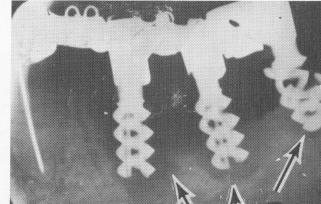
Fig. 14-7. The crystalline bone screw could be failing for two reasons other than poor design: it was screwed too deeply and could have sunk slightly through the superior wall of the mandibular canal, thus loosening the implant; or the hole made with the tap could have been too large, causing the failure.
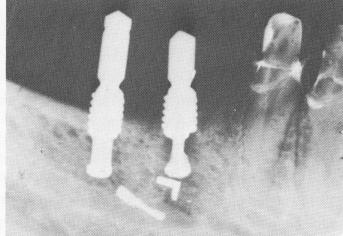
Fig. 14-8. A broken posterior implant occurred by trying to screw it deeper while the bone resisted. Osteolysis is caused by insufficient depths of implant and not by the broken screw. (From Linkow, L. I.: Alloplastic implants. In Gold-man, H. M., Forrest, S. P., Byrd, D. L., and McDonald, R. E.: Current therapy in dentistry, vol. 3, St. Louis, 1968, The C. V. Mosby Co., pp. 335-356.)
so that the spiral-post can be inserted to its maxi-mum depth.
The vent-plant, being self-tapping and stronger than the spiral-shaft implant because it is made of titanium rather than Vitallium, has much less chance of breakage when forced into position. Occasionally, however, vent-plants have broken (Fig. 14-9).
Another candidate for easy breakage is the narrow ridge implant (Fig. 14-10). If its site has not been properly prepared, it can be snapped while forcing it into the bone.
Breakage, which may be expected if the opera-tor persists in forcing the implant into the site, is usually detectable. When it occurs, the implant
Fig. 14-9. The uprights joining the threads with the apical ring of the vent-plant broke during its insertion because of improper use of the helical burs. A helical bur was used that had a narrower diameter than the apical ring (thereby placing a great deal of pressure and torque on the ring) that was smaller in diameter than the outer diameter of the implant threads.
should be removed. Whether or not the immediate reinsertion of another implant into the site is possible depends on the damage. If too much bone has been destroyed removing the broken implant, reinsertion should not be attempted until the bone has healed.
Dull instruments
The burs and taps used in dentistry can be used only a certain number of times before they become dull or fracture or break. As the tools become dull, the bone's resistance increases. This causes a great deal of friction that heats the bone, and heat can destroy bone.
The operator should always be sure that he has
|
Previous Page
|
Page 613 |
Next Page
|
|
Copyright warning: This information is presented here for free for anyone to study online. We own exclusive internet copyrights on all content presented on this website. We use sophisticated technology to identify and legally close down websites that reproduce copyrighted content without permission - so please don’t do it.
|