| Theories and Techniques of Oral Implantology (vol.2) (published 1970) | Dr. Leonard I. Linkow |
 Previous Page Previous Page
|
Next Page 
|
| This is an archival HTML version of this book originally hosted here in 2006. The HTML may not display well on modern browsers. Please view the modern PDF Version for a better viewing experience. |
Causes of implant failure 611
two choices are possible. If the operator wants to use a post type implant, he should allow the site to heal before performing the implantation; or, and this is now a very practical alternative, he could use a blade-vent.
IMPLANT DESIGN AND INSTRUMENTATION
One of the most basic considerations in implantology is using an implant design compatible with the biomechanical and physiologic forces typical of the site. Examples of failures caused by inappropriate implant design or excessively difficult operative procedures have been extensively covered elsewhere, particularly in Chapter 5. The following list summarizes the characteristics of a successful endosseous implant.
-
The implant must be made of an inert, biologically acceptable material.
-
It must be lightweight but strong, ductile, and difficult to break or fracture.
-
It must be radiopaque on x-rays.
-
It must be easy to insert.
-
It must be prefabricated for standardization and coordination of operative procedures.
-
Both the design and material of the implant must be able to withstand functional stress.
-
In design, the implant must be restricted at its neck, where it exits the alveolar bone and fibromucosal tissues.
-
The deepest portions should contain openings or vents, both to allow for the possibility of the bone growing through the openings and to permit the normal flow of blood and lymph, which aids healing.
-
The insertion of the implant should require a minimum of armamentarium.
-
The implant should be architecturally de-signed to provide immediate retention upon insertion.
Poorly designed implants
How just one uncompensated divergence from the list of implant design and insertion requirements can result in failure is summarized in Fig. 14-6. In A several implant designs are shown just after insertion. All are screw-type implants. Most are made of metal, but one is made of synthetic sapphire, all of which are known to be biologically inert materials. All were splinted for security, but B and C show what usually happens when a solid screw type implant with an unrestricted neck is used. Even though
broad-necked implants may be successful in some cases, there is a tendency for bone breakdown to occur with this type of design, no matter of what material it is constructed.
Proof that an unrestricted neck and a solid body in an implant can cause bone breakdown is shown in Fig. 14-7. To ensure that these particular design features, not the material of which the implant was made, caused the failures, Linkow coated several of his implant designs yv ith synthetic sapphire. Bone breakdown did not occur.
Fragile implants
Fragility of the material of which the implant is constructed or the design itself can lead to implant breakage during insertion. The majority of failures caused by implant breakage have occurred with those spiral-post implants made of Vitallium (Fig. 14-8). Vitallium is a brittle metal. The unique double-helical design, so advantageous to retention and fluid drainage, makes this type of implant weaker than some other, more sturdily constructed models. Because the spiral-post implant is not self-tapping, it must be inserted gently or it will fracture or break. In situations where resistance is met and the operator is sure that the implant has not been set deeply enough, the hole should be widened
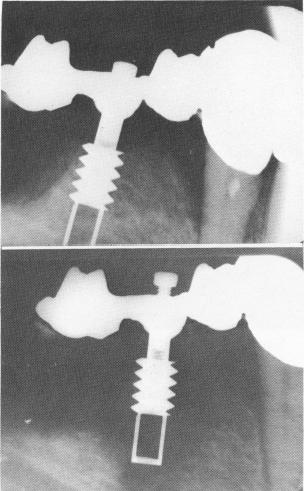
Fig. 14-5. A, A vent-plant placed too close to an open socket. B, The bone flanking the socket nearest the implant became undermined and resorption was the result.
A
B
|
Previous Page
|
Page 611 |
Next Page
|
|
Copyright warning: This information is presented here for free for anyone to study online. We own exclusive internet copyrights on all content presented on this website. We use sophisticated technology to identify and legally close down websites that reproduce copyrighted content without permission - so please don’t do it.
|