| Theories and Techniques of Oral Implantology (vol.2) (published 1970) | Dr. Leonard I. Linkow |
 Previous Page Previous Page
|
Next Page 
|
| This is an archival HTML version of this book originally hosted here in 2006. The HTML may not display well on modern browsers. Please view the modern PDF Version for a better viewing experience. |
Endodontic implants 585
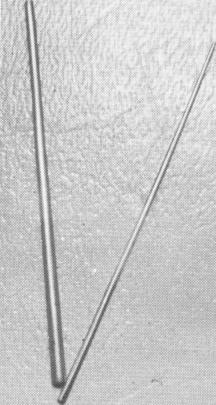
Fig. 13-5. Two of the many sized endodontic stabilizers. The rigid ones are cast in Vitallium*; the more resilient ones are tooled in titanium.'
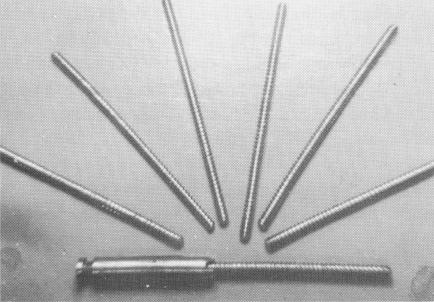
Fig. 13-6. Threaded endodontic stabilizers have also been used. The main advantage is that threading provides more retention for cementation to the inside walls of the root canal.
lum also would seem a good choice, it is considered by many operators to be too pliable.
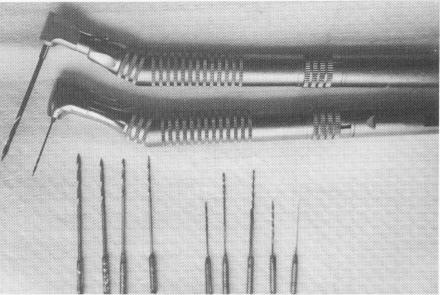
Drilling tools. Although in ordinary endodontic work reamers more than 23 mm. long and above gauge 5 or 6 are rarely required, reamers from 31 to 36 mm. with gauges up to 15 must be available for endodontic implants (Fig. 13-7). Until recently such reamers were handmade, but now a few manufacturers are producing them.
For drilling through the hard compact bone of
*Howmedica, Inc., Chicago, Ill.
f Park Dental Research, New York, N. Y.
Fig. 13-7. The engine-mounted tapered and cylindrical reamers, which are different in length: 21 mm., 30 mm., and 36 mm. Note the difference in working length between a normal reamer mounted on a normal contra-angle hand-piece (bottom) and a long reamer mounted on the miniature contra-angle handpiece (top). Another 2 mm. can be gained by using a pedohead contra-angle. Angle hand-pieces also permit easier viewing. (From Orlay, H. G.: Endodontic implants, J. Oral Implant Transplant Surg., pp. 44-53, 1965.)
the mandible, a cable dental engine is more powerful than the Doriot engine. This engine should be reinforced with a speed-reducer, which at the same time can also reduce the danger of overheating the bone. Further useful gadgets are a miniature, or lilliputian, contra-angle handpiece to drive the reamers deeper into the bone, a diamond disk to mark and cut the posts and to grind them if necessary, and some strong curved pincers to grip the implant posts firmly.
To keep the operational area free from flooding, saliva ejectors and walling the teeth with small inter-changeable gauze pieces suffice. Rubber-dam cover is also helpful.
Cements and filling materials. Once the site has been created, cement is needed to bind the implant to the root canal walls. For that portion of the stabilizer flush with the root apex, any nonsoluble endodontic cement may be used. The remainder of the stabilizer coronal to the root apex will be covered with oxyphosphate of zinc cement.
Because cement can irritate bone and prevent healing, a substance is needed to prevent it from reaching and filling the periapex. For this Kri paste is used. Kri paste is a mixture of iodoform powder with methylated and camphorated parachlorophenol. It was introduced into European endodontics for root canal filling by Professor Wlakhoff of Warzburg, Germany, about 1925. It was relatively
|
Previous Page
|
Page 585 |
Next Page
|
|
Copyright warning: This information is presented here for free for anyone to study online. We own exclusive internet copyrights on all content presented on this website. We use sophisticated technology to identify and legally close down websites that reproduce copyrighted content without permission - so please don’t do it.
|