| Theories and Techniques of Oral Implantology (vol.2) (published 1970) | Dr. Leonard I. Linkow |
 Previous Page Previous Page
|
Next Page 
|
| This is an archival HTML version of this book originally hosted here in 2006. The HTML may not display well on modern browsers. Please view the modern PDF Version for a better viewing experience. |
Subperiosteal implants 541
remedied by making a horizontal incision inferior to the exposed strut and severing the high muscle attachment. No sutures are made, and the tissue is treated so that healing takes place by secondary, rather than primary, intention. This relieves the pulling action of the attachment and allows the tissue to grow upward to cover the neck.
Closing the site
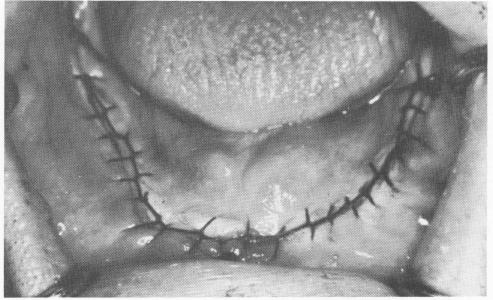
After the necessary impressions have been made, the site is sutured closed. This may be done with interrupted sutures, or surgical ties, which are a series of separate sutures placed about %4 inch apart. The knots should be made to one side of the wound so that they will not press on it. Alternately, the sutures may be continuous, uniting the wound from one end to the other. Suturing in this manner is started by passing the needle through one edge of the wound and tying a simple knot. The edges of the wound are then pierced successively, making sure that the thread directly behind the needle is always under it, until the end of the wound is reached and closed with a terminal surgical knot (Fig. 12-21) . Both interrupted and continuous suturing close the wound by bringing the edges together.
When the tissues are under unusual tension, as sometimes occurs between the abutment posts, surface-to-surface adaptation of the wound is prefer-able to edge-to-edge contact. This may be achieved with mattress sutures. Mattress sutures may be continuous or interrupted and may be buried. They do not tear the tissues as readily as surface interrupted sutures. Mattress suturing is sometimes done in combination with interrupted surgical ties.
A mattress or purse-string suture is used around each protruding post to circumvent and tightly join the tissues around the posts. Sometimes, because of the quality and thickness or thinness of the tissue, as well as its shrinkage caused by excessive time spent in making the surgical impression, tension sutures may have to be applied. This type of suturing is usually used in large open wounds to distribute the pull on the sutures over as large a surface area as possible. The needle is passed through the tissue about 1 inch away from the wound on one side and is brought out and passed through near the end of the wound on the other side. The needle is then passed back near the edge of the tissue on the first side and swept through the tissue on the opposite side about 1 inch away from the incision.
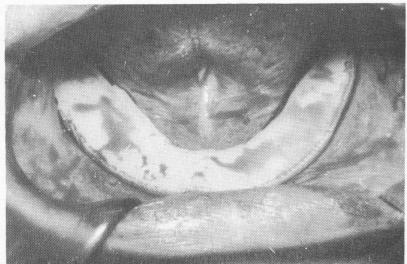
When the wound has been closed, an intraoral bandage* may be set over it to speed healing (Fig. 12-22). In addition to protecting the wound, the bandage provides medication. To make the bandage, a portion is cut to fit over the entire wound area. The paper covering the adhesive is removed and the bandage positioned and held for about 30 seconds. The adhesive contains hydrophilic compounds that hold the bandage in place from 6 to 12 hours. If possible, it is better to leave the bandage in place 24 hours.
Using a temporary denture
The patient will need a temporary denture both for functional use and to protect the wound while it is healing. Most of the patients requiring a full lower subperiosteal implant usually have a number
*E. R. Squibb & Sons, New York, N. Y.
Fig. 12-21. There must always be enough sutures to completely close the wound. This case shows continuous suturing completely around the arch from retromolar pad to retromolar pad.
Fig. 12-22. An intraoral bandage (E. R. Squibb and Sons) is sometimes used directly over the sutured tissue.
|
Previous Page
|
Page 541 |
Next Page
|
|
Copyright warning: This information is presented here for free for anyone to study online. We own exclusive internet copyrights on all content presented on this website. We use sophisticated technology to identify and legally close down websites that reproduce copyrighted content without permission - so please don’t do it.
|