| Theories and Techniques of Oral Implantology (vol.2) (published 1970) | Dr. Leonard I. Linkow |
 Previous Page Previous Page
|
Next Page 
|
| This is an archival HTML version of this book originally hosted here in 2006. The HTML may not display well on modern browsers. Please view the modern PDF Version for a better viewing experience. |
534 Theories and techniques of oral implantology
A
B
Any and all local pathologic conditions must first be alleviated before proceeding with the bone impression for the subperiosteal implant. Any remaining root tips, residual cysts, amalgam fillings trapped in a healed open socket, knife-edge or spiculed ridges, or hypertrophied tissue covering the mandibular bone should all be treated at least 3 to 6 months prior to implant intervention. In situations where unilateral subperiosteal implants are contemplated and some of the remaining teeth are to be utilized as natural tooth abutments, there should be no decay, abscess, or pulpitis. The mobility, periodontal condition, and occlusion of the remaining teeth should be checked.
Last, but hardly least, the operation and its prognosis should be thoroughly discussed with the patient before any work is done. The patient should
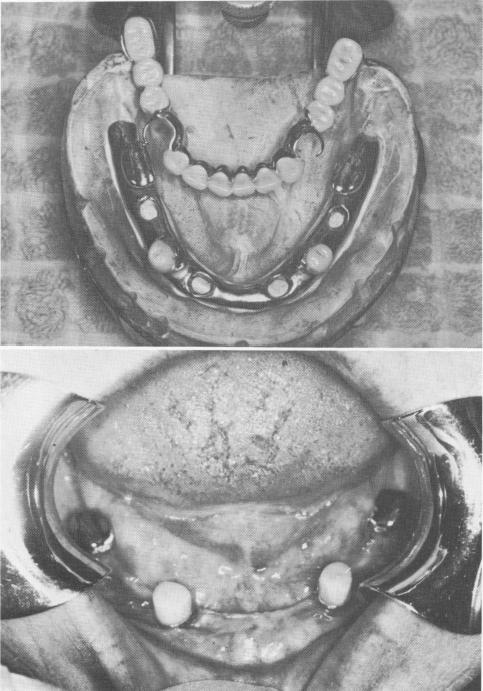
Fig. 12-6. A, A Vitallium template that was cast from a revised stone model taken from an original alginate impression of the soft tissues. The stone model is scraped to assimilate the topography of the underlying bone by the use of radiographs. (Courtesy A. Gershhoff and N. I. Goldberg.) B, The same case as it appears in the mouth 20 years later.
never be made to feel that his implant denture will be an overwhelming success. The entire truth about its limitations should be presented. However, many patients who were otherwise considered to be dental cripples with their routinely constructed denture have been helped greatly by the introduction of the subperiosteal implant and, in years to come, many more patients will be helped. The fact that the subperiosteal method of approach has not been used more widely has nothing to do with the degree of success. Statistical analyses of subperiosteal implants successfully functioning many years have been frequently reported and authoritatively documented (Fig. 12-6).
According to Cranin: "If the fearless practitioner who attempts to construct a conventional denture prosthesis for a totally atrophic mandibular ridge would apply the same perseverance, courage, and skill to mastering the implant technique, the problems of edentulous patients would be relegated to that small group for whom implants are contraindicated. With a greater number of doctors practicing the technique, fears would be dissipated (as they are always with the introduction of knowledge), and the implant [would] cease to be looked upon as a radical procedure to be recommended only for severely crippled patients."
Today, when some operators using modern approaches have been achieving as much as 95% success with their patients, the prognosis is optimistic.
A FULL ARCH SUBPERIOSTEAL IMPLANT
One, two, or three visits are usually required for a subperiosteal procedure. On the first, usually when the patient accepts the diagnosis and agrees to the procedure, a surgical tray to be used later for taking a bone impression is made. The following two visits are surgical, one for making the bone impression and the other for inserting the implant. Some operators prefer to hospitalize their patients for surgical visits; others prefer to have their patients ambulatory and to perform the operations in their office. The choice depends on the operator's own preferences and the patient's condition, mental as well as physical.
Obtaining the surgical tray
An acrylic surgical tray is needed to make an accurate bone impression (Fig. 12-7). Some operators make an alginate impression of the entire lower jaw over the soft tissues to make the tray. Others, including Linkow, prefer to fabricate a more accurate tray by reflecting the soft tissues to reveal
|
Previous Page
|
Page 534 |
Next Page
|
|
Copyright warning: This information is presented here for free for anyone to study online. We own exclusive internet copyrights on all content presented on this website. We use sophisticated technology to identify and legally close down websites that reproduce copyrighted content without permission - so please don’t do it.
|