| Theories and Techniques of Oral Implantology (vol.2) (published 1970) | Dr. Leonard I. Linkow |
 Previous Page Previous Page
|
Next Page 
|
| This is an archival HTML version of this book originally hosted here in 2006. The HTML may not display well on modern browsers. Please view the modern PDF Version for a better viewing experience. |
504 Theories and techniques of oral implantology
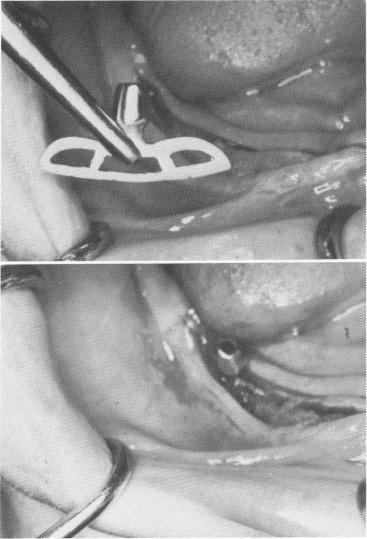
The edentulous ridge was injected with bilateral nerve blocks as well as infiltration anesthesia (Fig. 11-136) . An incision was made along the crest of the ridge from retromolar pad area to retromolar pad area. The tissues were reflected to expose the bone. The groove for the first blade was made in
Fig. 11-137. Because there was not enough alveolar bone above the mandibular canal, a narrow blade was inserted. Careful evaluation of the x-rays before implant insertion helped ensure the appropriate blade.
the right molar area and the implant was set into it and tapped in until its shoulders were buried between the existing cortical plates (Fig. 11-137).
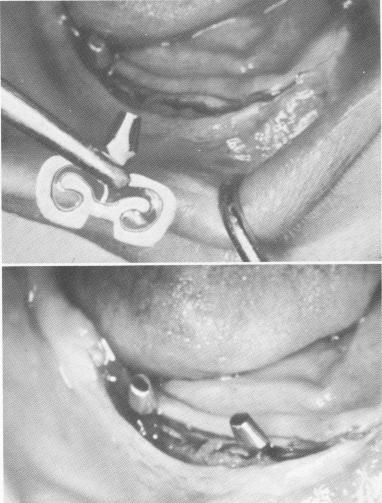
The second groove was made in the cuspid-bicuspid area. (If it is necessary to curve the groove in this area to follow the crest, the implant can be
Fig. 11-138. Because more bone existed anteriorly, a blade longer in its superior and inferior dimensions was used.
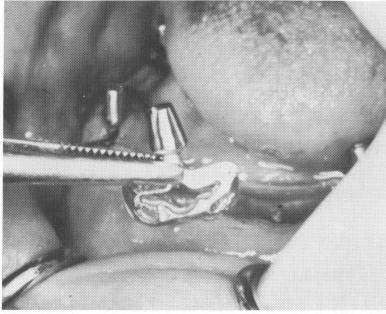
Fig. 11-139. Because there was not enough room to place double-headed blades that were wider anteriorly and posteriorly, four smaller single-headed blades were used.
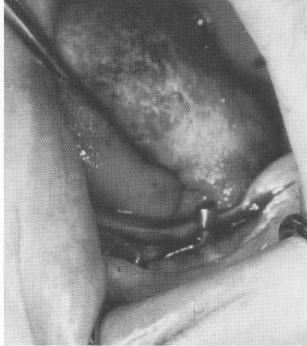
Fig. 11-140. A curved blade was used to follow the contour of the bone in the left cuspid region.
|
Previous Page
|
Page 504 |
Next Page
|
|
Copyright warning: This information is presented here for free for anyone to study online. We own exclusive internet copyrights on all content presented on this website. We use sophisticated technology to identify and legally close down websites that reproduce copyrighted content without permission - so please don’t do it.
|