| Theories and Techniques of Oral Implantology (vol.2) (published 1970) | Dr. Leonard I. Linkow |
 Previous Page Previous Page
|
Next Page 
|
| This is an archival HTML version of this book originally hosted here in 2006. The HTML may not display well on modern browsers. Please view the modern PDF Version for a better viewing experience. |
Endosseous blade implants 503
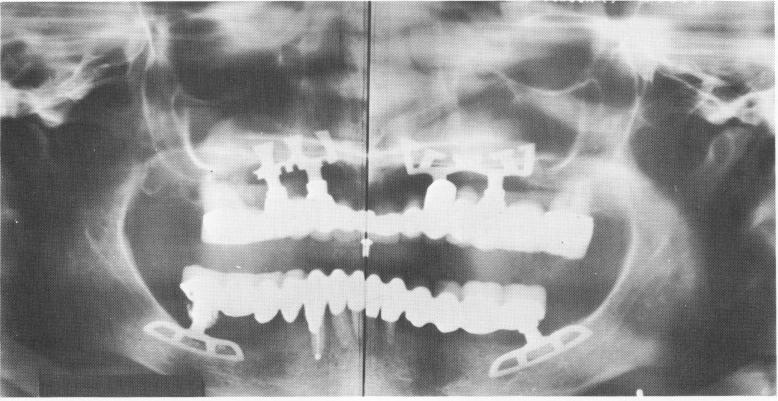
Fig. 11-135. A Panorex of the completed case. Although there are only two blades, each spans an area previously occupied by four teeth. The obvious stability against lateral dislodgment is evident.
work is once again replaced. After it sets, the entire framework is picked up with a full mouth alginate (irreversible hydrocolloid) impression, and a new master stone model is poured and articulated for the completion of the prosthesis.
By the next visit the tissue was completely healed (Fig. 11-132). The case was tried while still in the "biscuit bake" stage and any necessary adjustments were made (Fig. 11-133) .
The final visit consisted of cementing the prosthesis with hard cement (Fig. 11-134) and last-minute spot-grinding. The final Panorex illustrates the extreme versatility and usefulness of blade implants (Fig. 11-135) . It is Linkow's firm opinion that placing the blades into such a narrow ridge actually widens it by the wedge action of the blades. A blood clot forms that differentiates into fibrous tissue that eventually fills in with bone by intramembranous bone formation. The implants, when placed into proper function, continue to stimulate the bone to continue its osteogenic activities. Dozens of knife-edge ridges similar to this case have been restored in this manner and are all still functioning success-fully.
THE EDENTULOUS MANDIBLE
Restoring an edentulous jaw with endosseous implants, even prior to the evolution of the blade variety, has been more successful in the mandible than in the maxilla. Mandibular bone is much denser and the thick cortical plate along the alveolar crest
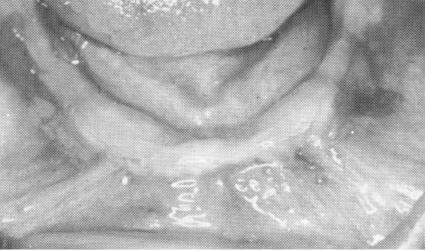
Fig. 11-136. The edentulous mandible.
provides an ideal brace for the shoulders of the blade. The law of gravity also favors lower implant cases as compared with upper ones.
The major considerations in inserting blades in the edentulous mandible are determining the most appropriate implant sites and creating grooves of the proper depth and width so that the blades can be tapped into the bone with a minimum of trauma.
The following sample case is typical of most blade implant restorations for the mandible.
Case 11
A typical restoration for an edentulous mandible
First, radiographs were taken to determine the height of alveolar bone above the mandibular canals and mental foramina. Based upon studies of these, four blades of the proper design and size were selected.
|
Previous Page
|
Page 503 |
Next Page
|
|
Copyright warning: This information is presented here for free for anyone to study online. We own exclusive internet copyrights on all content presented on this website. We use sophisticated technology to identify and legally close down websites that reproduce copyrighted content without permission - so please don’t do it.
|