| Theories and Techniques of Oral Implantology (vol.2) (published 1970) | Dr. Leonard I. Linkow |
 Previous Page Previous Page
|
Next Page 
|
| This is an archival HTML version of this book originally hosted here in 2006. The HTML may not display well on modern browsers. Please view the modern PDF Version for a better viewing experience. |
Endosseous blade implants 505
easily bent with pliers to conform to it.) The implant was slightly curved, set in its groove, and tapped into position (Fig. 11-138) . The left posterior blade was inserted (Fig. 11-139), and then the left anterior blade was appropriately curved and tapped to its proper depth (Fig. 11-140) .
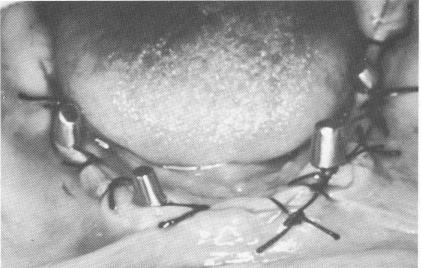
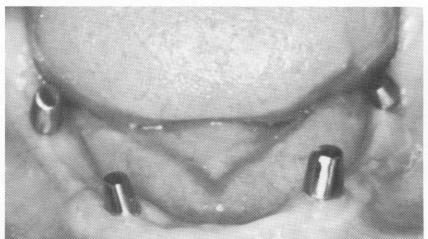
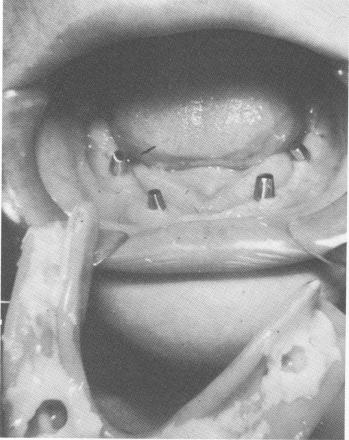
The tissues were adapted and sutured with simple surgical ties (Fig. 11-141) . When the sutures were removed (Fig. 11-142), the patient's old denture was hollowed out, lined with a soft tissue reliner, and used as a temporary splint until the final prosthesis could be fabricated (Fig. 11-143).
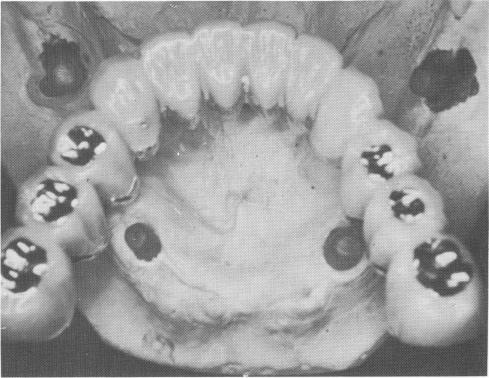
Impressions were taken with the necessary bite registrations for the fabrication and completion of the full arch fixed denture. In this case the final prosthesis was acrylic over gold, with six gold occlusal stops (Fig. 11-144). It was cemented into position with hard cement (Fig. 11-145). The teeth were carefully and accurately spot-ground in the mouth for final balancing.
A Panorex shows the edentulous mandible with four blades supporting the full arch fixed denture (Fig. 11-146, A).
It should be noted that the implants used in this
Fig. 11-141. The tissues were sutured over the implants.
Fig. 11-143. The patient's old denture, relined with soft tissue conditioner, was placed temporarily over the implants. To make the posts parallel prior to final impressions, they were ground directly in the mouth.
Fig. 11-142. The excellent healing around each implant post is evident 2 weeks postoperatively. Note also the lack of parallelism, which resulted from the fact that these earlier types of blades were cast in cobalt-chrome, which could not be bent. Also, the hardness of the metal made it extremely difficult to parallel the posts with grinding stones. In spite of this, note the excellent condition of the tissues around each post.
Fig. 11-144. An acrylic-over-gold full arch fixed denture with six gold occlusal stops is seen on the stone model.
|
Previous Page
|
Page 505 |
Next Page
|
|
Copyright warning: This information is presented here for free for anyone to study online. We own exclusive internet copyrights on all content presented on this website. We use sophisticated technology to identify and legally close down websites that reproduce copyrighted content without permission - so please don’t do it.
|