| Theories and Techniques of Oral Implantology (vol.1) (published 1970) | Dr. Leonard I. Linkow |
 Previous Page Previous Page
|
Next Page 
|
| This is an archival HTML version of this book originally hosted here in 2006. The HTML may not display well on modern browsers. Please view the modern PDF Version for a better viewing experience. |
The evolution of dental implants 145
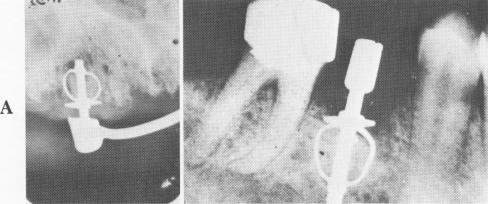
Fig. 5-14. A, Lehman's implant used successfully. Notice the bone regrowth through the band. B, Although the uppermost part of the implant is quite close to the alveolar crest, bone appears to have filled in well around the band and lower post. (From Chercheve, R.: Les implants endoosseux, Paris, 1962, Librairie Maloine.)
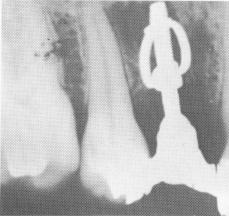
Fig. 5-15. Little bone regrowth is seen here because soft tissues have replaced bone in the band and around the post itself. (From Chercheve, R.: Implants endo-osseux, Paris, 1962, Labrairie Maloine.)
chances of widening the slit and perforating the bone are great. After a successful slit has been created, a bur is used to create a hole deep enough to accept the post. The site is cleansed, the implant set, and the mucosa sutured over the site.
In addition to the cautious operative procedure necessary to create the walls of the slit, the implantologist must take great care to create a slit deep enough to set the bands well into bone. Bone can, and should, condense around the band (Fig. 5-14). This is frequently a problem. Because the post necessitates having deep alveolar bone, the implant may not be used in numerous sites because of danger to vital anatomic landmarks. Also, because the band leaves a large "empty" area within it, the danger of soft tissue invagination is great (Fig. 5-15) .
Attempting to design a simple implant that was easy to insert and that provided for the regrowth of bone through it, the Parisian technician P. Pretto fashioned the trombone implant (Fig. 5-16) . This implant contains a long, large area through which hone can grow, a good feature. Unfortunately, how-ever, the length of this implant and the smoothness of its sides are disadvantageous. Because inserting the implant requires removing a cylinder of bone slightly larger than the trombone, a fairly large area becomes involved in the regeneration of bone and
Fig. 5-16. Pretto's trombone implant. Because of its length, it was difficult to bury deep enough in bone. Also, its smooth sides provided little surface for retention. (Courtesy P. Pretto.)
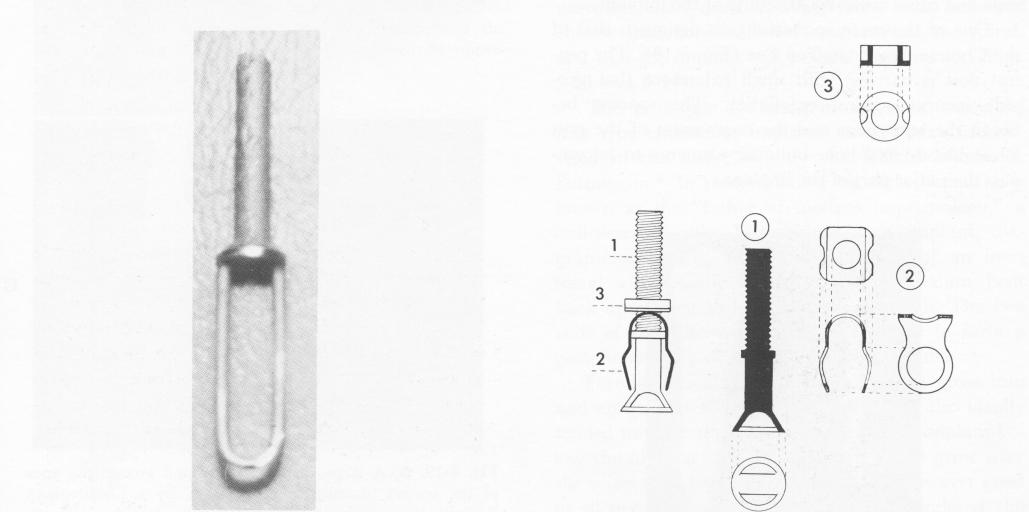
Fig. 5-17. The adjustable winglet implant, another Pretto design, incorporated winglcts through which bone might regrow. When a disk (3) is screwed over the implant shaft (1), the winglet band (2) flares. (Courtesy P. Pretto.)
|
Previous Page
|
Page 145 |
Next Page
|
|
Copyright warning: This information is presented here for free for anyone to study online. We own exclusive internet copyrights on all content presented on this website. We use sophisticated technology to identify and legally close down websites that reproduce copyrighted content without permission - so please don’t do it.
|