| Theories and Techniques of Oral Implantology (vol.1) (published 1970) | Dr. Leonard I. Linkow |
 Previous Page Previous Page
|
Next Page 
|
| This is an archival HTML version of this book originally hosted here in 2006. The HTML may not display well on modern browsers. Please view the modern PDF Version for a better viewing experience. |
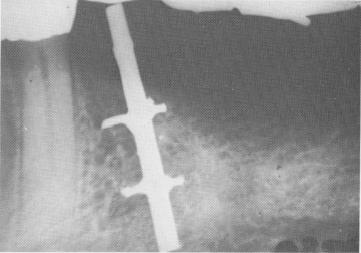
Fig. 5-20. Another successful case using Lee's implant. Notice that bone has grown right up to the post, holding the implant tight in its site. (Courtesy T. C. Lee.)
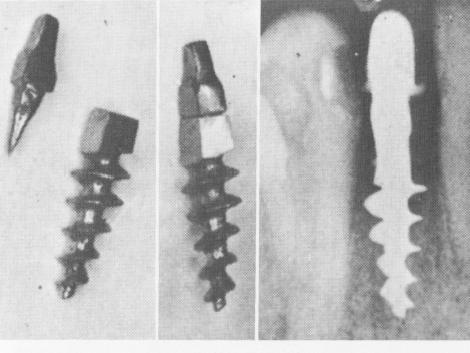
Fig. 5-21. An early Tramonte implant, a modified orthopedic screw with a broad two-piece head. Because of the large impact area, bone could not grow around the upper-most spires. (Courtesy S. Tramonte.)
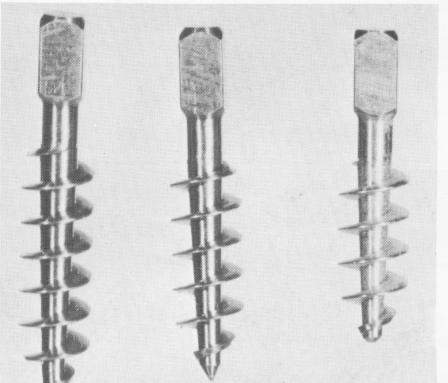
Fig. 5-22. Tramonte's later narrow-necked implant, mad 3f titanium. It is still a modified orthopedic screw but mud mproved, with allowances for dental use. (Courtesy 5 Tramonte.)
The evolution of dental implants 147
Fig. 5-19 gives ample proof that a well-designed implant can be successful. The case illustrates a 13-year follow-up. A shows extensive bone destruction around the tooth, particularly at its apex. In B, the implant is seen 9 months after its insertion into the open socket. Although the site has not healed as satisfactorily as might have been expected at this time, no evidence of further damage is seen. Notice that the implant has been stabilized by bridging it to abutment teeth. Thirteen years after insertion (C), it is clear that the implant continues to be functional. Bone is seen around the implant, and there is no evidence of infection.
Another example of the Lee implant is seen in Fig. 5-20. Again the implant was placed in an open socket, and bone has clearly grown around it. Lee's results attribute to his skill both as a designer and as a practitioner.
The implants of the Italian Stefano Tramonte closely resemble the screws used by orthopedic surgeons. The wide head of Tramonte's first implants often produced poor results (Fig. 5-21). This wide head provided too broad an impact area and invited soft tissue invagination. In a later Tramonte design, the prosthesis-bearing shaft is narrower than the spiral portion (Fig. 5-22). With this type of design, as long as the operator inserts a good portion of the narrower shaft deep in bone, there is an excellent chance that bone will condense around the spirals and that the implant will be held quite secure (Figs. 5-23 and 5-24).
The prototype for some of the most successful post type endosseous implants in use today was devised in the mid-1940's by the Italian Manlio S. Formiggini.* In recognition of his contribution he is known as the "father of modern implantology," a well-deserved title. Formiggini's early implant, diagrammed in Fig. 5-25, was fashioned of an inert metal wire, usually stainless steel or tantalum, bent back upon itself to form a series of spirals. The two ends of the wire were soldered together to form a post, or stem, on which the prosthesis was set.
Formiggini's design allowed tissues to grow into and around the spires of the implant. It also ideally tended to place the wider portions of the implant be-low the alveolar crest so that bone could grow over the spires as a deterrent to exfoliation. However good in theory, several mechanical factors hindered the success of Formiggini's early implant. Today we can
*Formiggini, ,M. S.: Protesi dentaria a mezzo di infibulazioni diretta endoalvelare, Rev. Ital. Stomat., March, 1947.
|
Previous Page
|
Page 147 |
Next Page
|
|
Copyright warning: This information is presented here for free for anyone to study online. We own exclusive internet copyrights on all content presented on this website. We use sophisticated technology to identify and legally close down websites that reproduce copyrighted content without permission - so please don’t do it.
|