| Theories and Techniques of Oral Implantology (vol.1) (published 1970) | Dr. Leonard I. Linkow |
 Previous Page Previous Page
|
Next Page 
|
| This is an archival HTML version of this book originally hosted here in 2006. The HTML may not display well on modern browsers. Please view the modern PDF Version for a better viewing experience. |
The evolution of dental implants 155
and it must be carefully inserted to avoid breakage. Previously, similar implants were inserted by using burs to drill sites large enough to bear the implant. Estimating just how large was a trial-and-error procedure; the operator frequently created a far too generous site. This made it difficult to stabilize the implant.
By carefully designing burs and taps to complement the implant, the field of implantology took a large step forward. In Chercheve's method, the site is prepared to the desired depth with round burs, followed by helical burs, and then taps prepare the site to accept the implant. In this way, the implant fits quite snugly in its site from the beginning, helping avoid the problems arising from a loose-fitting implant.
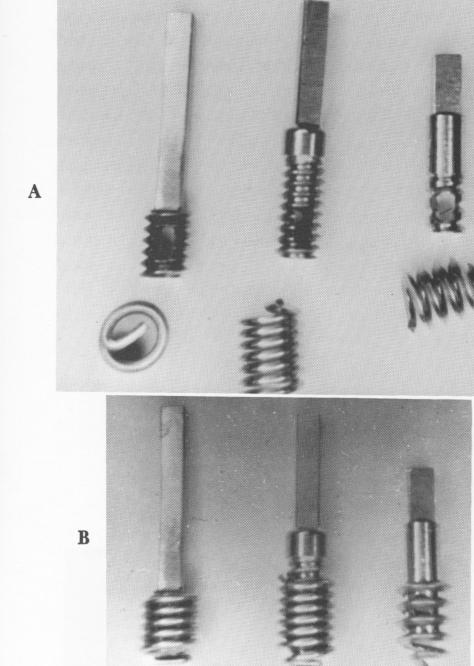
Fig. 5-39. The coil, or spring, implants of Trattner (left) redesigned by Lew (center) and Linkow (right). The coil is inserted first, and the abutment-bearing post is immediately inserted in it. A, The implants disassembled; B, the coils with posts in place. In addition to the coils of two implants being too close together, the insertion technique of all three is awkward.
The promise inherent in the spiral design stimulated several implantologists to attempt other variations. Max Jeanneret, known in Europe for his studies on parallelism, tried to make it possible to use spiraled implants in sites where there was insufficient alveolar bone. To do this, he designed a three-part implant that provided for screwing on the prosthesis (Fig. 5-38). He planned to insert the implant at the angle afforded by the alveolar bone. Then he would fit the prosthesis in place and insert the screw in the artificial tooth at whatever angle necessary to fasten it to the implant. By this device he hoped to get around the requirement that the abutment post be parallel to remaining teeth.
The idea, although ingenious, didn't work. It was much too difficult trying to fit a screw through a prosthesis into an obliquely set implant. For parallel insertion, the implant—although it was well de-signed with widely spaced spirals—is very bulky, which limits its use in narrow sites, and it is too thick around the portion that penetrates the soft tissues covering the alveolar crest.
In addition to experimenting with posts incorporating spirals, some designers separated the spirals into a separate coil or spring (Fig. 5-39) . Basically
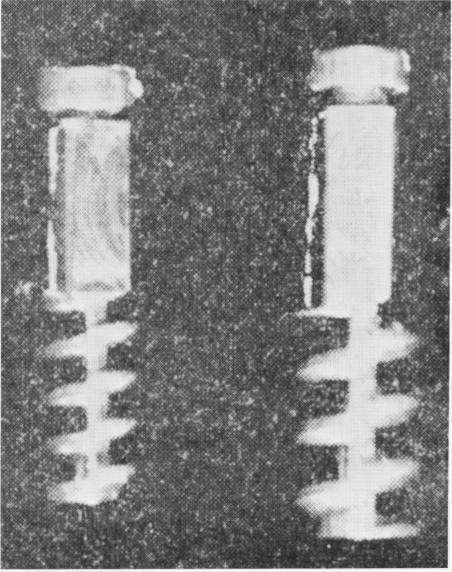
Fig. 5-40. Muratori's early implant, with its bulky broad shaft. (Courtesy G. Muratori.)
|
Previous Page
|
Page 155 |
Next Page
|
|
Copyright warning: This information is presented here for free for anyone to study online. We own exclusive internet copyrights on all content presented on this website. We use sophisticated technology to identify and legally close down websites that reproduce copyrighted content without permission - so please don’t do it.
|