| Theories and Techniques of Oral Implantology (vol.1) (published 1970) | Dr. Leonard I. Linkow |
 Previous Page Previous Page
|
Next Page 
|
| This is an archival HTML version of this book originally hosted here in 2006. The HTML may not display well on modern browsers. Please view the modern PDF Version for a better viewing experience. |
154 Theories and techniques of oral implantology
bone regrowth. Also, drainage from the onset of insertion is facilitated by wider open spirals. This initial drainage is sometimes necessary and helps prevent pain and swelling. To ensure that the spirals were buried well away from the crest, Chercheve also used a longer abutment post. This provided an additional advantage—a shelf of bone grows over the spirals, making exfoliation even more difficult (Fig. 5-35).
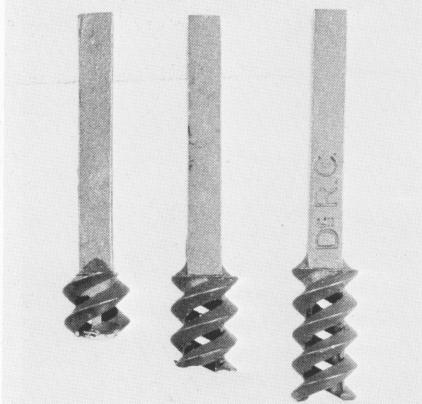
In order to safely increase the space between the spirals and to easily modify their number, Chercheve designed the double-helical spiraled implant (Fig. 5-36). The double-helical feature evolved in recognition that it was not the number of spirals that was important but their spacing and depth in bone (Fig. 5-37). The double-helical design capitalizes on the advantages of spirals and allows more leeway in their number. If the spiraled portion is too large, some of the spirals can be cut off without damaging the stability of the implant.
Perhaps Raphael Chercheve's greatest contribution to implantology was his firm belief that a design cannot be separated from its method of insertion. Therefore, to insert his spiral-shaft he created a method of insertion carefully coordinated to the demands of the design and to the ultimate health of the site.* The spiral-shaft is a delicate implement,
*Chercheve, R.: Les implants endo-osseoux, Paris, 1962, Librairie Maloine, p. 181.
Fig. 5-36. The double-helical spiraled implant of Raphael Chercheve. This excellent double-helical idea capitalizes on the advantages of the spiral idea and permits modification of the length of the implant by cutting off the lowermost spirals until the implant suits the site.
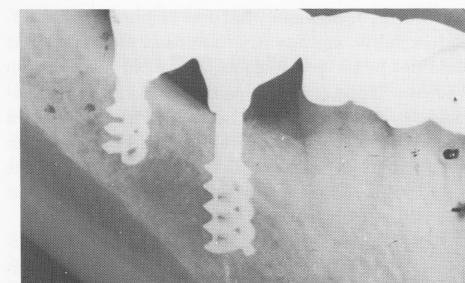
Fig. 5-37. Two double-helical cast Vitallium Chercheve implants placed by Linkow acting as posterior abutments for a fixed partial denture. Note the beautifully healed sites.
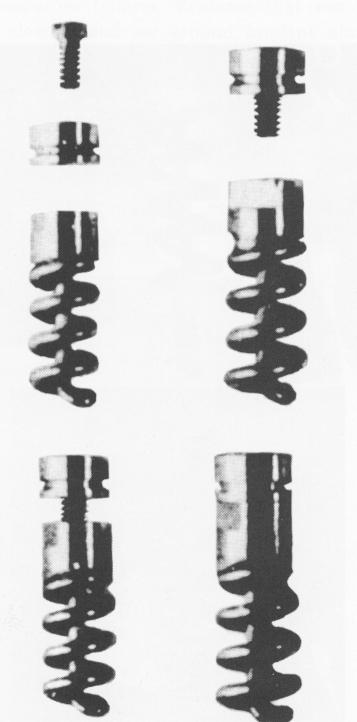
Fig. 5-38. Jeanneret's three-piece implant. It has a thick shaft to permit the separate pieces to be screwed together. Its thickness is its flaw; the spirals are adequately spaced. (From Linkow, L. I.: Clinical evaluation of the various designed endosseous implants, J. Oral Implant Transplant Surg. 12:38, 1966.)
|
Previous Page
|
Page 154 |
Next Page
|
|
Copyright warning: This information is presented here for free for anyone to study online. We own exclusive internet copyrights on all content presented on this website. We use sophisticated technology to identify and legally close down websites that reproduce copyrighted content without permission - so please don’t do it.
|