| Maxillary Implants (published 1977) | Dr. Leonard I. Linkow |
 Previous Page Previous Page
|
Next Page 
|
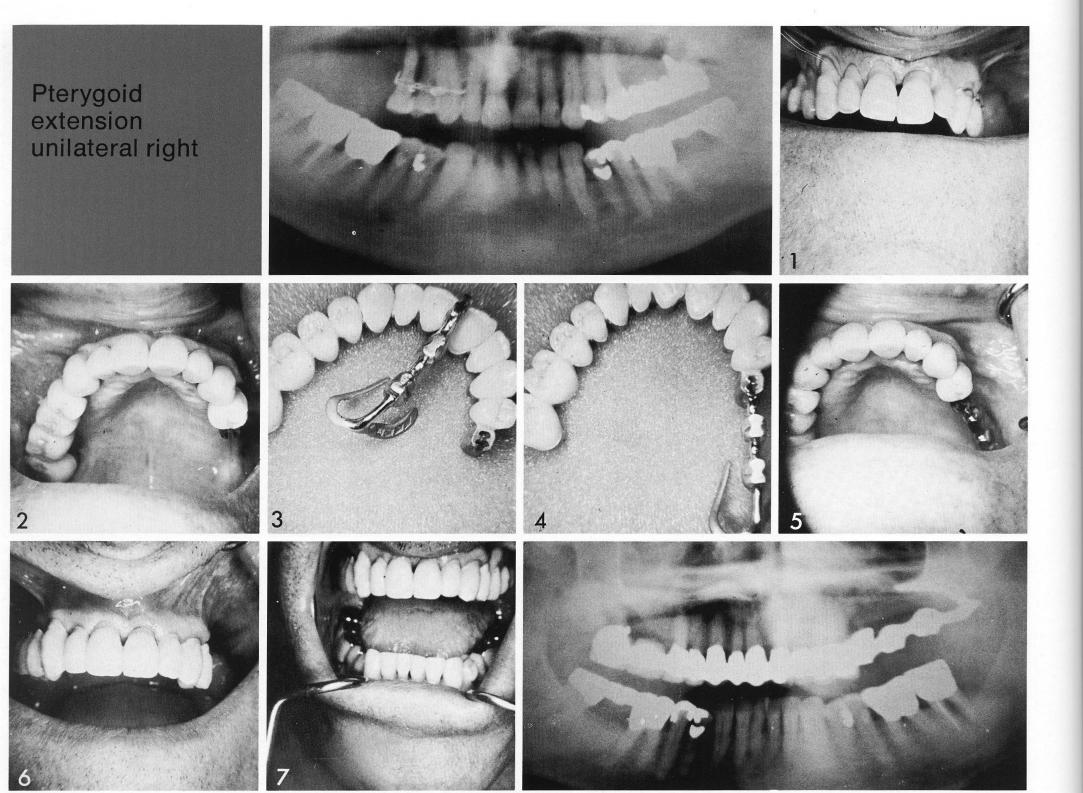
Pterygoid extension
unilateral right
Use of the unilateral pterygoid extension implant has been very satisfying. This is one of the older cases. The patient's remaining teeth were unattractive (I), so they were restored first (2). The site was revealed, and an impression taken of the bone. The entire bridge with its distal pontic and the bone impression were then picked up with a full plaster impression. The resulting unilateral pterygoid extension implant was designed to link anteriorly with the female attachment (3,4). The restoration was refitted, and the implant inserted. After the tissues over the pterygoid extension implant healed (5), an impression was taken for the final three-unit splint that would complete the restoration (7). The age of this pterygoid extension implant can be deduced from its design. Early designs, such as this, had narrow palatal and buccal arms embracing the tuberosity, and a bar arising directly from the hamular notch.
240
|
Previous Page
|
Page 240 |
Next Page
|
|
Copyright warning: This information is presented here for free for anyone to study online. We own exclusive internet copyrights on all content presented on this website. We use sophisticated technology to identify and legally close down websites that reproduce copyrighted content without permission - so please don’t do it.
|