| Theories and Techniques of Oral Implantology (vol.2) (published 1970) | Dr. Leonard I. Linkow |
 Previous Page Previous Page
|
Next Page 
|
| This is an archival HTML version of this book originally hosted here in 2006. The HTML may not display well on modern browsers. Please view the modern PDF Version for a better viewing experience. |
Atypical implant situations 661
severe bruxism (Fig. 15-104). The patient had been wearing a stainless steel lingual bar type removable denture to replace posterior teeth on both sides of his mandible. His completely edentulous maxilla was restored with his fifth conventional denture, the previous four having been broken by grinding.
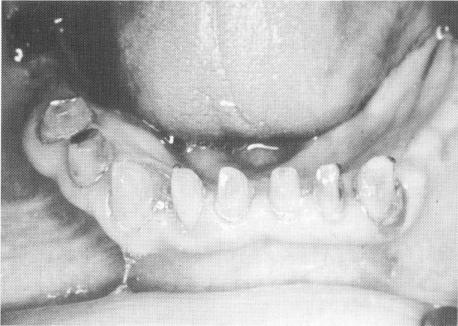
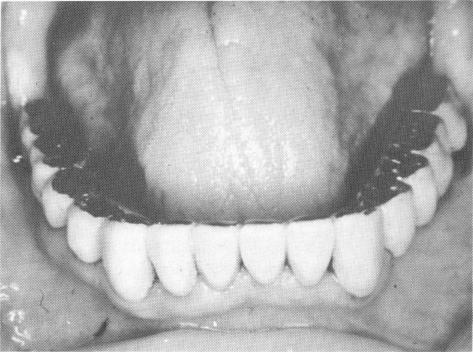
The remaining mandibular teeth were prepared for full crown restorations, and blade implants were placed in both posterior edentulous areas (Fig. 15-105) . A full arch fixed prosthesis was fabricated and cemented over the implants and teeth (Fig. 15-106) .
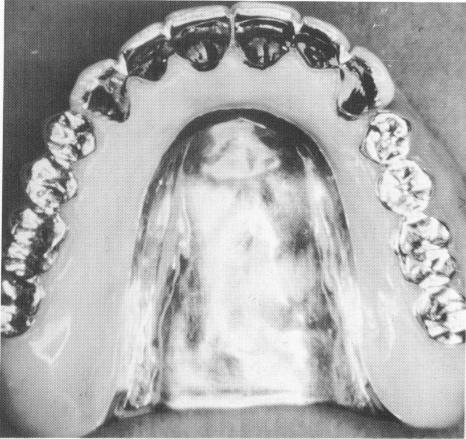
Because there was not enough bone for implants, the new maxillary prosthesis was a full arch re-movable denture. This denture contained acrylic teeth and a cast gold palate to resist breakage.
It was decided to open the bite. Because some wearing away of the acrylic maxillary teeth was
Fig. 15-105. The mandibular teeth were prepared, and a blade implant was placed posteriorly on each side of the mandible.
Fig. 15-106. The full arch fixed prosthesis cemented in position.
anticipated, the posterior maxillary teeth were made slightly longer than the anticipated distance that the bite was to be opened. Once wear patterns had been established, gold onlays were planned.
After approximately 4 months, facets appeared on the occlusal surfaces of the acrylic teeth of the maxillary denture. After taking an alginate impression of the entire denture, the occlusal surfaces of all maxillary teeth were reduced 1 mm. To ensure that the onlays would be perfectly set, parallel vertical holes were made in each tooth to accept ready-made plastic pins. The teeth were thoroughly lubricated and the pins inserted.
Melted blue inlay wax was poured into the alginate impression of the original occlusal surfaces, and the alginate impression was quickly placed over the denture with its newly reduced teeth. When the wax had cooled, the resulting pattern was an exact replica of the worn occlusal pattern of the teeth. The entire wax pattern with the attached plastic pins was removed, sprued, and cast in gold. It was then cemented into position over the prepared acrylic denture teeth (Fig. 15-107). The denture was fitted in the mouth, and the articulation was once again carefully checked for any prematurities (Fig. 15-108) .
Case 12
Stabilizing a fixed bridge over a long edentulous span
When the terminal abutment tooth or teeth sup-porting a fixed bridge have lost a great deal of bone
Fig. 15-107. The maxillary denture contained a cast gold palate and acrylic teeth with gold occlusal surfaces.
|
Previous Page
|
Page 661 |
Next Page
|
|
Copyright warning: This information is presented here for free for anyone to study online. We own exclusive internet copyrights on all content presented on this website. We use sophisticated technology to identify and legally close down websites that reproduce copyrighted content without permission - so please don’t do it.
|