| Theories and Techniques of Oral Implantology (vol.2) (published 1970) | Dr. Leonard I. Linkow |
 Previous Page Previous Page
|
Next Page 
|
| This is an archival HTML version of this book originally hosted here in 2006. The HTML may not display well on modern browsers. Please view the modern PDF Version for a better viewing experience. |
Atypical implant situations 659
the arch (Fig. 15-96) . After cleansing with peroxide, the hollowed-out interior was packed with a filling material that takes on the same shade as the tooth.* The crown was replaced, positioned properly, and re-moved before the material hardened. After hardening in hot water for 5 minutes, the tooth was refitted and readjusted. A twin arch band with a rigid wire extending lingually to the center of each neighboring tooth was provided by the orthodontist (Fig. 15-97) .
*Adaptic, made by Johnson & Johnson, New Brunswick, N. J.
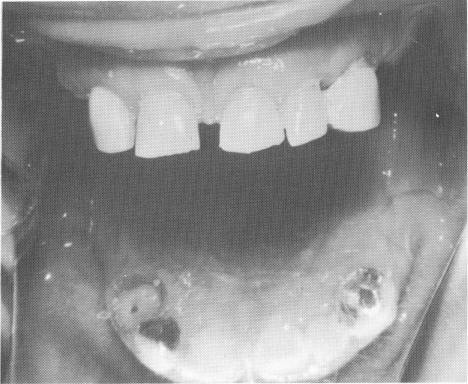
Fig. 15-99. A maxillary arch with six loose teeth and a large anterior diastema.
The band was cemented over the original tooth crown with hard cement, and the crown was cemented over the implant post. After removing the hardened excess cement, the natural tooth crown was ligated with .010 stainless steel to the labial arch wire for support during bone regeneration (Fig. 15-98).
Case 10
Restoring a maxillary arch with a large anterior diastema
Dealing with a large space between two maxillary incisors is particularly difficult when the few remaining anterior teeth are periodontally involved. A cumbersome removable appliance would seriously threaten such teeth. As for the diastema, the patient may be used to it and also fear that obliterating the gap will make the central incisors undesirably large and bulky. In such a situation, Linkow uses posterior blade type implants to permit full arch splinting and yet still maintain the anterior diastema.
In this case there are six anterior periodontally involved teeth, including only a root of the right
cuspid, and a large diastema between both central incisors (Fig. 15-99) . The teeth were prepared, and
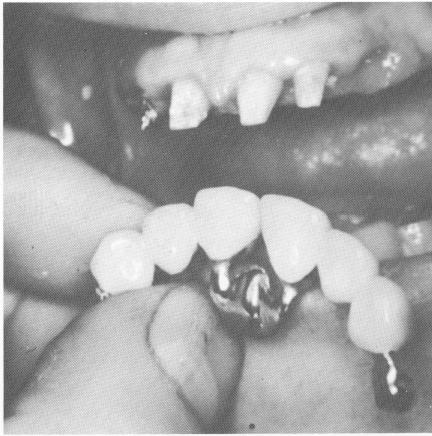
castings made with palatal extensions emanating from the lingual shoulders of the central incisor copings.
The copings were not over-built to close the diastema.
The castings were fitted in the mouth and a wax
Fig. 15-100. The anterior restoration—both quadrants joined by a palatal plate—was fitted in the mouth. The diastema was still present.
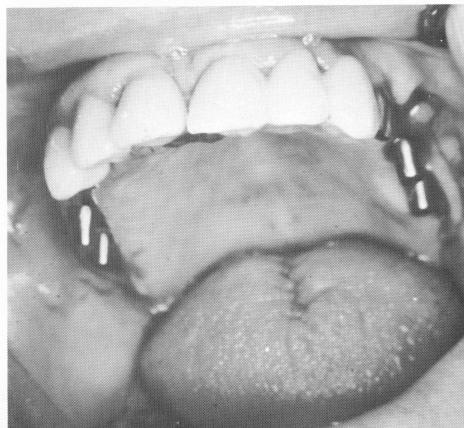
Fig. 15-101. Blade implants were set into the two posterior edentulous areas.
|
Previous Page
|
Page 659 |
Next Page
|
|
Copyright warning: This information is presented here for free for anyone to study online. We own exclusive internet copyrights on all content presented on this website. We use sophisticated technology to identify and legally close down websites that reproduce copyrighted content without permission - so please don’t do it.
|