| Theories and Techniques of Oral Implantology (vol.2) (published 1970) | Dr. Leonard I. Linkow |
 Previous Page Previous Page
|
Next Page 
|
| This is an archival HTML version of this book originally hosted here in 2006. The HTML may not display well on modern browsers. Please view the modern PDF Version for a better viewing experience. |
Atypical implant situations 657
inside of buccal tubes (Fig. 15-94). The rest of the procedure follows that described previously.
Case 9
Using a single tooth blade implant supported by a labial arch appliance
A young girl undergoing orthodontic treatment for malocclusion lost her maxillary central incisor in an accident. Her orthodontist utilized the lost incisor as a space maintainer by removing the root at the cementoenamel junction and banding the remaining coronal portion with a twin arch band ligated to the labial arch wire (Fig. 15-95). This held the tooth in position for 3 years, at which time it became necessary to replace this temporary device since orthodontic treatment was nearing completion. Because the girl's anterior teeth were caries-free, her parents were reluctant to have them prepared for full crown coverage, especially at such an early age. Thus a single tooth implant intervention was discussed and agreed upon.
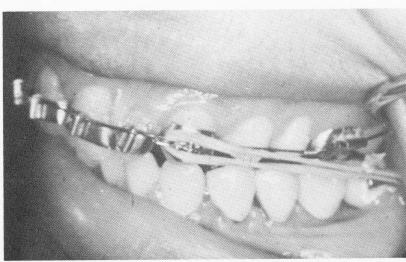
Fig. 15-92. A four-unit bridge was cemented over the two bicuspid teeth and implant post. The last crown had a buccal tube attached.
A specially designed single tooth blade implant was inserted, and the wound was closed with two small sutures. The coronal portion of the original tooth, which was exactly the same color as the other anterior teeth, was hollowed out to fit loosely over the implant post, thus permitting easy alignment in
.040 rigid wire
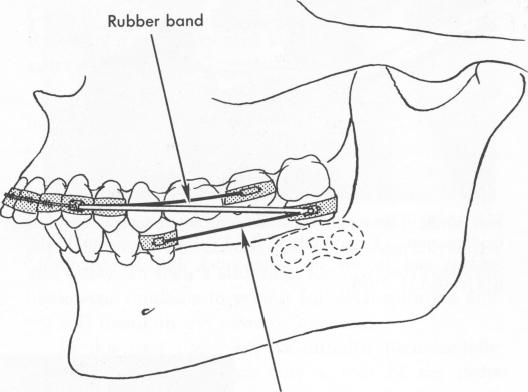
Fig. 15-94. A diagram of another way to accomplish the same results. The rubber band extends from the maxillary hook, which is attached to the labial arch wire in the region of the cuspid, to the buccal tube, which is attached to the buccal surface of the crown covering the implant in the edentulous molar area. In order to stabilize and splint the implant to the anterior abutment tooth so that it can be strong enough to serve as an anchor for the distal movement of the anterior and posterior quadrant of rnaxillary teeth, a rigid .040 wire is soldered to the inside of the buccal tubes of both abutments. In this case, the bicuspid tooth was also banded and the buccal tube soldered to it.
Rubber band
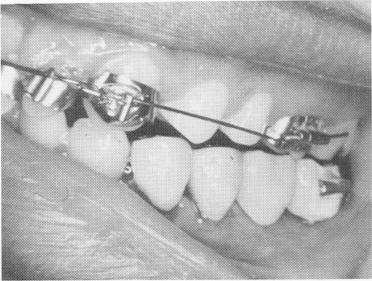
Fig. 15-93. Distal movement of the posterior quadrant of teeth can now be managed using the implant as the intraoral anchorage. In this manner the patient, being an adult, did not have to use an extraoral head or neck band.
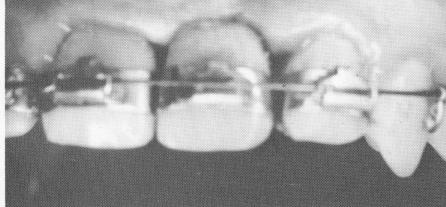
Fig. 15-95. The coronal portion of the left central incisor was attached to the labial arch wire. No root portion of the tooth existed. (From Linkow, L. I.: The endosseous blade implant and its use in orthodontics, Int. J. Orthodont. 8 [4] :149-154, 1969.)
|
Previous Page
|
Page 657 |
Next Page
|
|
Copyright warning: This information is presented here for free for anyone to study online. We own exclusive internet copyrights on all content presented on this website. We use sophisticated technology to identify and legally close down websites that reproduce copyrighted content without permission - so please don’t do it.
|