| Theories and Techniques of Oral Implantology (vol.2) (published 1970) | Dr. Leonard I. Linkow |
 Previous Page Previous Page
|
Next Page 
|
| This is an archival HTML version of this book originally hosted here in 2006. The HTML may not display well on modern browsers. Please view the modern PDF Version for a better viewing experience. |
592 Theories and techniques of oral implantology
A
C
should be kept clean between sessions by sealing a temporary post into it.
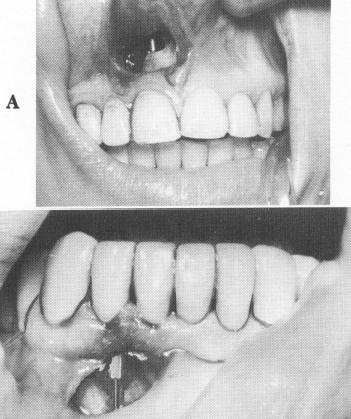
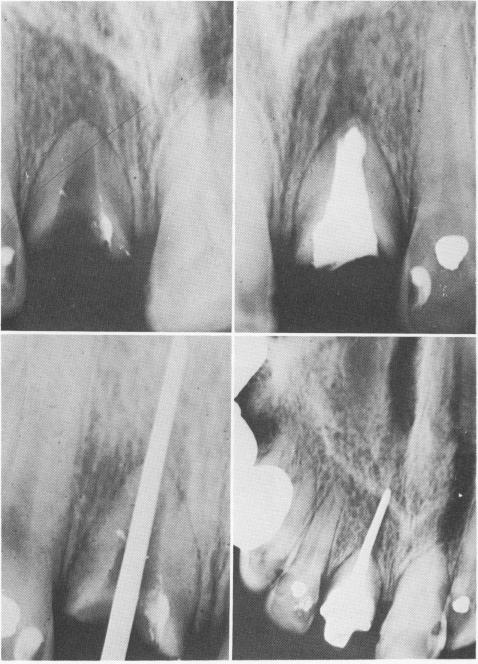
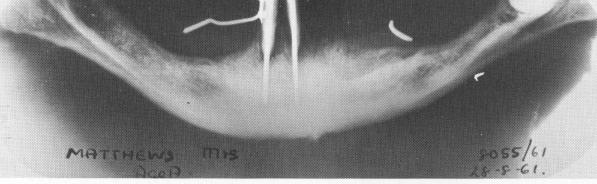
A potentially widespread use of endodontic implants is the conservation and stabilization of remaining natural teeth for use as bridge abutments (Fig. 13-18). The stabilized teeth help prevent denture shifting and its consequent problems.
The left second molar, saved as a posterior abutment for a fixed partial denture in Fig. 13-19, has been radically treated with an endodontic implant. The obliquely set stabilizer has been functioning well for 5 years. Because the tooth is so extremely tipped mesially, the implant acts as a mesial root.
Even part of a tooth may be saved to act as an abutment post, as shown in Fig. 13-20. Here only
Fig. 13-16. Endodontic root stabilizers are useful in con-junction with apicoectomies to reestablish the root-to-crown ratio. A, A maxillary case; B, a mandibular case. (From Linkow, L. I.: Pin implants, Prom. Dent. 3:4-15, 1968.)
one root of a multirooted tooth remains, the others having been removed either because of a bifurcation or trifurcation involvement or because of a periapical lesion. Complete bone healing can readily be seen.
The reimplantation of teeth may be facilitated
Fig. 13-17. Lengthening a short root to accept a restoration. A, An extremely short root on a central incisor prevented a retentive fitting post crown. B, The short root was first prepared and filled with Kri I paste. C, The Virilium post was fitted and cemented. D, the tooth was still functioning more than 4 years later. (Courtesy H. G. Orlay.)
B
B
D
Fig. 13-18. Stabilizers are most successful in the lower anterior region. Their greatest value is in stabilizing the few remaining teeth so that they could be used as abutments for the support of a partial removable appliance instead of a full denture.
|
Previous Page
|
Page 592 |
Next Page
|
|
Copyright warning: This information is presented here for free for anyone to study online. We own exclusive internet copyrights on all content presented on this website. We use sophisticated technology to identify and legally close down websites that reproduce copyrighted content without permission - so please don’t do it.
|