| Theories and Techniques of Oral Implantology (vol.2) (published 1970) | Dr. Leonard I. Linkow |
 Previous Page Previous Page
|
Next Page 
|
| This is an archival HTML version of this book originally hosted here in 2006. The HTML may not display well on modern browsers. Please view the modern PDF Version for a better viewing experience. |
558 Theories and techniques of oral implantology
A
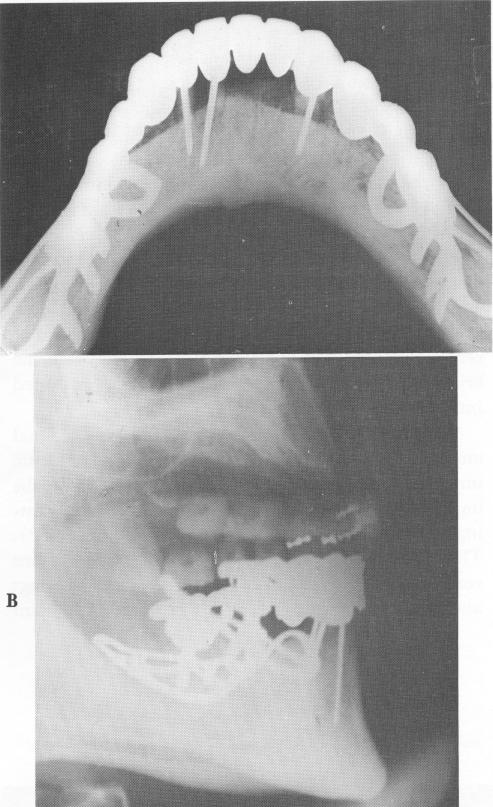
Fig. 12-69. A, A cross-sectional occlusal x-ray showing both subperiosteal implants in close position over the bone. Three endodontic root stabilizers were used to stabilize the three remaining anterior teeth. B, A lateral plate showing the subperiosteal implants and endodontic stabilizers in position.
posts. Also, no solder joints are needed. The bridges are then cemented (Fig. 12-68).
Radiographs of the finished case are seen in Fig. 12-69.
MAXILLARY SUBPERIOSTEAL IMPLANTS
For many years American operators have avoided maxillary subperiosteal implants. A few practitioners, including Gershkoff and Goldberg, have reported some long-term maxillary implant successes functioning over 10 years, but most operators have been discouraged by the high proportion of failures. From
other countries come reports of greater success. Bello from South America claimed that a maxillary subperiosteal implant that he did on his wife was functioning splendidly after 12 years. Salagaray and Sol of Spain and Audoire of France have been doing successful subperiosteal implants in the maxilla for a number of years.
Failures in the maxillary subperiosteal implants have been attributed mainly to poor design of the framework and poor surgical and impression techniques. However, the most common cause of failure may be attributed to the fact that there is little dense bone in the maxilla to bear the subperiosteal implant. Whereas the mandible usually has relatively flat dense cortical plates after alveolar bone resorption, the maxilla resorbs to thin, irregular ridges frequently knife-edged--with a very thin layer of cortical bone, especially over the posterior ridges.
Many different designs have been created for maxillary subperiosteal implants, some of which included the hard palate while others did not. In Linkow's opinion, the following design features should be included for the maxillary superiosteal implant to enjoy long-term success. There should be a minimal amount of primary struts across the alveolar bone. Strong bony landmarks should be used as foundations. These include the base of the anterior nasal spine, the zygomatic arch, the canine eminence, and sometimes the lateral surface of the pterygoid plate (Fig. 12-70). A brace should be laid across the hard palate. The anterior and posterior palatal struts going from left to right should be as far away from one another as pos ible, with a few cross struts between them.
In addition to the contraindications typical to all implant candidates, a maxillary subperiosteal implant should never be done if the mandible has a full cornplement of natural teeth or if the patient suffers with sinusitis, postnasal drip, or similar conditions.
To take the bone impression, the site is anesthetized. Two percent lidocaine and epinephrine 1:100,000 infiltration injections are given in the buccal and labial folds, palatal tissue, and infraorbital regions. Posterior superior alveolar and anterior palatine injections also may be given, if desired.
The fibromucosal tissue is incised down to the bone around the entire crest of the ridge, from maxillary tuberosity to maxillary tuberosity (Fig. 12-71) .
The tissue is retracted with a periosteal elevator, and the eggshell thin periosteum is carefully separated from the underlying bone without tearing it (Fig. 12-72). If the periosteum is badly mutilated, an increased amount of bone resorption will occur
|
Previous Page
|
Page 558 |
Next Page
|
|
Copyright warning: This information is presented here for free for anyone to study online. We own exclusive internet copyrights on all content presented on this website. We use sophisticated technology to identify and legally close down websites that reproduce copyrighted content without permission - so please don’t do it.
|