| Theories and Techniques of Oral Implantology (vol.2) (published 1970) | Dr. Leonard I. Linkow |
 Previous Page Previous Page
|
Next Page 
|
| This is an archival HTML version of this book originally hosted here in 2006. The HTML may not display well on modern browsers. Please view the modern PDF Version for a better viewing experience. |
Endosseous blade implants 473
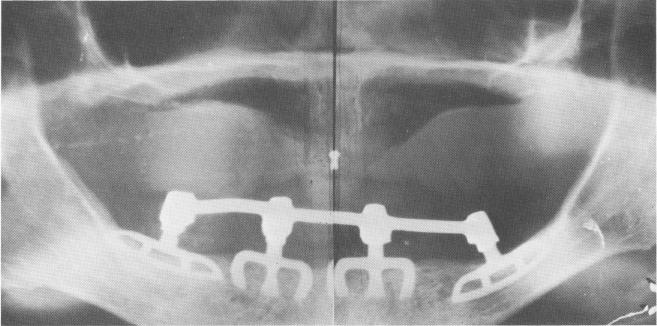
Fig. 11-26. Four blades, splinted with a connecting bar mesostructure, provide more than adequate support for a removable denture.
border is interrupted, less malleting pressure is needed to tap the implant to its desired depth. Also, less bone is sacrificed than when using a blade with a continuous border. Accordingly, areas of greater porosity require blades with more secondary struts to provide greater contact surface and support (Fig. 11-23).
17. Whereas most other types of implants are contraindicated for an open socket, the blade-vent is ideal. Because of its length, its most mesial and distal ends extend beyond the socket and can be em-bedded in bone (Fig. 11-24). If there is not enough flanking bone and the bone below the socket is deep, a specially designed blade can be driven below the socket. Or, if there is enough bone around the socket, a curved blade may follow the socket's con-tour.
18. The blades adapt themselves excellently in combination with other types of screw and pin implants in the same mouth (Fig. 11-25).
19. Because the blades are so self-retentive, there is no need for a template. The additional support and stress-distributing properties of a template would be superfluous with blade implants, whereas with triplants a template is essential.
20. Blades are the strongest design to date for the support of a removable prosthesis. If a removable prosthesis is desired, the blades' protruding posts are splinted with a fixed dolder bar, which will serve as a mesostructure (Fig. 11-26) .
SHORT EDENTULOUS SPANS
The blade has been very successfully used in single tooth restorations, in restorations for free-end saddle areas, and as supports in areas flanked by
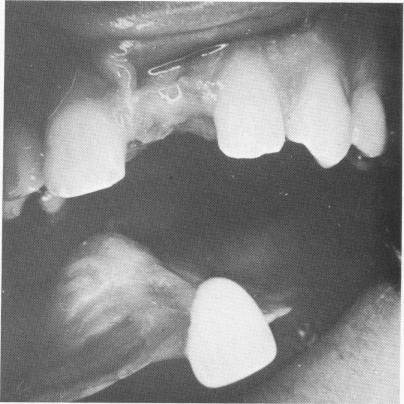
Fig. 11-27. A missing left maxillary central incisor originally restored with a removable prosthesis.
teeth. Because the design is adaptable, the implant may be fashioned to suit the particular demands of the site.
Case 1
A single tooth blade implant for the maxilla
Although other single tooth implants cannot be left unsplinted immediately after insertion, the prognosis with a blade implant seems to be much more hopeful. Also, unlike screw and pin implants, the restoration does not have to be prefabricated for a blade-vent.
In this case a restoration for a left central maxillary incisor was planned (Fig. 11-27) . The fibro-
|
Previous Page
|
Page 473 |
Next Page
|
|
Copyright warning: This information is presented here for free for anyone to study online. We own exclusive internet copyrights on all content presented on this website. We use sophisticated technology to identify and legally close down websites that reproduce copyrighted content without permission - so please don’t do it.
|