| Theories and Techniques of Oral Implantology (vol.1) (published 1970) | Dr. Leonard I. Linkow |
 Previous Page Previous Page
|
Next Page 
|
| This is an archival HTML version of this book originally hosted here in 2006. The HTML may not display well on modern browsers. Please view the modern PDF Version for a better viewing experience. |
130 Theories and techniques of oral implantology
of new bone, not of the type of bone that might have reformed if the implant had settled into existing bone. Rather surprisingly, immature bone was found to front on the areas previously occupied by the inferior lateral curvature of the implant. Apparently the connective tissue had been replaced by immature bone.
The findings in the two series of sections made next to and directly through the abutment posts revealed the extent of epithelial imagination around the abutment post of a successful subperiosteal implant. In the series made immediately posterior to the implant abutment (Fig. 4-102), the oral mucosa was covered with a thick layer of nonkeratinized strati-
fled squamous epithelium. This thinned out along the strut as it extended away from the abutment until only typical implant connective tissue lined the space. The connective tissue underlying the epithelium contained a few lymphocytes and plasma cells, no more than is typical of chronic inflammation often associated with the gingival sulcus of a normal tooth.
There was a hill of bone between the peripheral frame and the secondary strut, indication that the implant apparently settled slightly in this region.
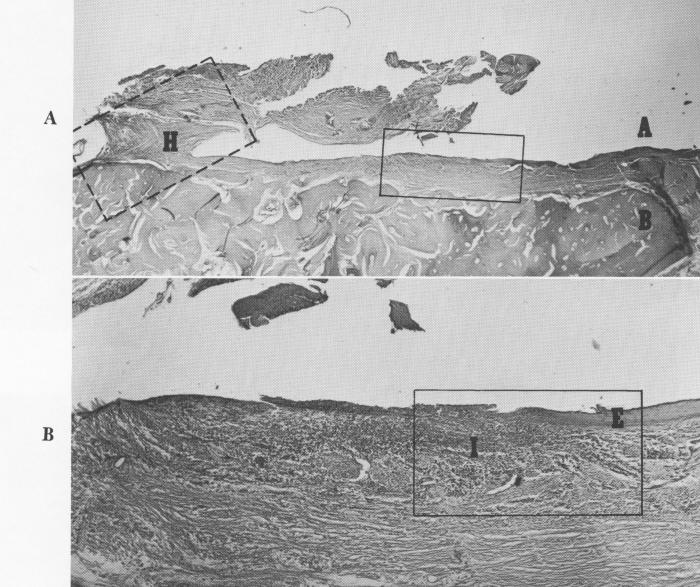
Several buccolingual sections were made directly through the abutment penetration site (Fig. 4-103). Under the abutment post itself, between the metal
Fig. 4-103. A, A section made through the abutment penetration site (A) and the buccal screw hole (H) contains the thickest soft tissue observed in any section. Note the thickness between the abutment site and the underlying bone (B). B, Higher magnification of the boxed area shows that the stratified squamous epithelial layer (E) thins as it moves away from the abutment penetration site. Under and apparently preceding the epithelial layer is an area of inflammation (I). C, An enlargement of B shows the nature and relationships of the epithelial and inflammatory layers. Note that the inflammatory cells are more numerous where the epithelium disappears. D, Magnification of the dashed box in A. This represents the buccal screw space which was left empty. Dense connective tissue (Ct) proliferated through the empty hole, forming a mushroom-shaped extension of the healthy underlying connective tissue. (From Bodine, R. L., Jr., and Mohammed, C. I.: Histologic studies of a human mandible supporting an implant denture, J. Prosth. Dent. 21 [2] :203-216, 1969.)
|
Previous Page
|
Page 130 |
Next Page
|
|
Copyright warning: This information is presented here for free for anyone to study online. We own exclusive internet copyrights on all content presented on this website. We use sophisticated technology to identify and legally close down websites that reproduce copyrighted content without permission - so please don’t do it.
|