| Theories and Techniques of Oral Implantology (vol.1) (published 1970) | Dr. Leonard I. Linkow |
 Previous Page Previous Page
|
Next Page 
|
| This is an archival HTML version of this book originally hosted here in 2006. The HTML may not display well on modern browsers. Please view the modern PDF Version for a better viewing experience. |
138 Theories and techniques of oral implantology
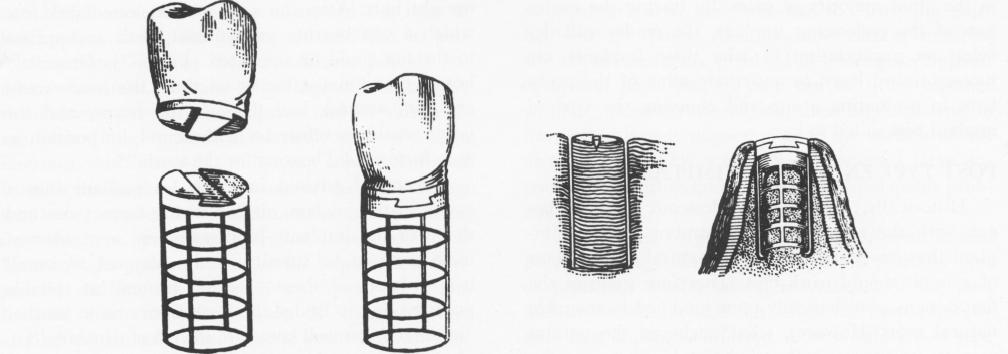
Fig. 5-4. Greenfield's later implant, proposed in 1913, was modified so that a core of bone could be left in the implant site. (From Greenfield, E. J.: Une racine artificielle, le Laboratoire et le Progres Dentaire Reunis, 15 January, 1911.)
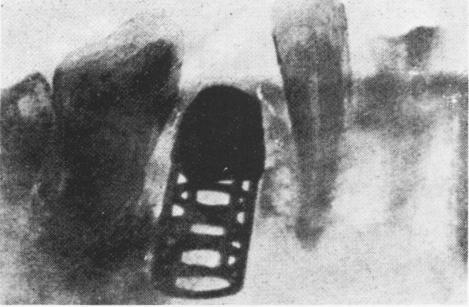
Fig. 5-5. Roentgenogram of Greenfield's 1913 implant fitted over an intact core of bone. (From Greenfield, E. J.: Implantation of artificial crown and bridge abutments, Dent. Cosmos 4:364, 1913.)
to the other. The resulting stress on the implants probably prevented the sites from healing adequately. In any case, the large impact area incorporated in his design might well have caused an individual implant splinted only to neighboring natural teeth to fail. It is to Greenfield's great credit, however, that he recognized and provided for sufficient re-growth of bone around the base of his implant by using the cage device. Also, his idea of leaving a core of bone in the site to serve as an inducement for the deposition of new bone has been successfully incorporated in some modern implant designs.
After Greenfield, little innovation in the field of implantology was forthcoming until the Strock
brothers published their results. Alvin E. Strock and Moses Strock, working at the Surgical Laboratory of Harvard Medical School and the Dental Service of the Peter Bent Brigham Hospital, did a great deal of carefully annotated work in the late 1930's and 1940's.* They experimented to overcome what they considered the two main reasons for implant failures: the use of biologically active metals and improper biomechanics. To exclude extraneous factors, they limited themselves to individual tooth restorations, using the screw principle for fixation.
Using Vitalliurn, the alloy recommended by Venable, Stuck, and Beach, the Strocks experimented on both clogs and humans. Among their experiments was the insertion of a 5/8-in., orthopedic type Vitallium screw into the left maxillary cuspid of a dog (Fig. 5-6). The screw was placed so that it was in occlusion when the jaws were closed. Some resorption occurred at first. However, 5 months later the screw was firmly affixed and could not be moved labiopalatally or rotated. A few other experiments using a screw of the same design were satisfactory.
In a human, the orthopedic-like Vitallium screw was used in the socket of a recently extracted mandibular right central incisor (Fig. 5-7). A celluloid crown form filled with a silicate cement was placed over the screw head for esthetic reasons. The patient immediately after insertion was, and continued to be, pain-free. About 8 months after the insertion,
*Strock, A. E.:, Experimental work on a method for the replacement of missing teeth by direct implantation of a metal support into the alveolus, Amer. J. Orthodont. Oral Surg. 25(5):467-472, 1939.
|
Previous Page
|
Page 138 |
Next Page
|
|
Copyright warning: This information is presented here for free for anyone to study online. We own exclusive internet copyrights on all content presented on this website. We use sophisticated technology to identify and legally close down websites that reproduce copyrighted content without permission - so please don’t do it.
|