| Theories and Techniques of Oral Implantology (vol.1) (published 1970) | Dr. Leonard I. Linkow |
 Previous Page Previous Page
|
Next Page 
|
| This is an archival HTML version of this book originally hosted here in 2006. The HTML may not display well on modern browsers. Please view the modern PDF Version for a better viewing experience. |
The evolution of dental implants 143
posts were then inserted. No crowns were placed over the protruding posts. The patient could chew with the posts quite freely and did not experience any unfavorable symptoms. Seven months after their insertion, some bone regrowth could be seen around the bases of the implants.*
In another patient, whose case is visually documented in Fig. 5-9, another specially shaped Vitallium implant was inserted after the extraction of a maxillary right lateral incisor. No attempt was made to clean out the diseased area because the Strocks deliberately chose to take unfavorable cases and try to have them do well. Six months after the insertion the "tooth [was] firm and a good member of the dental arch." f
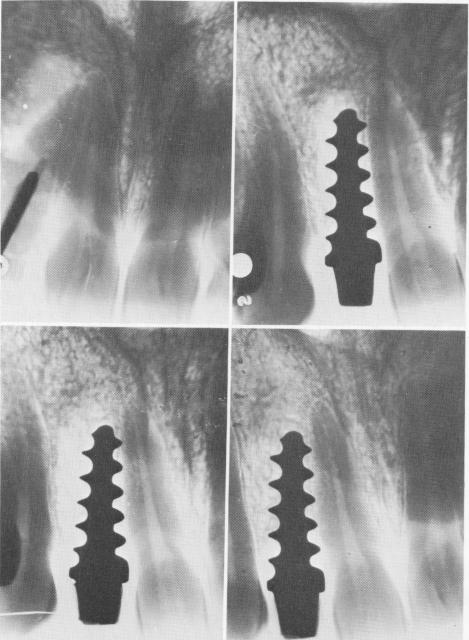
In still another case, done in 1938, a single tooth implant was inserted into the socket of an upper left lateral. As late as 1955, 17 years later, the implant was still functioning (Fig. 5-10).$
Today we can point out several factors in the Strocks' work that might lead to implant failure. First, by limiting themselves to a single tooth implant, the Strocks hoped to, and probably did, avoid the problems that can arise from undue stress on an implant by surrounding teeth or overall poor occlusion. However, an individual implant is subject to a great deal of trauma from movements of the tongue, cheeks, or lips against a protruding post. For this reason, an individual implant must be immediately stabilized and protected by a prosthesis that is in proper occlusion with the opposing arch. Second, an implant set in an open socket frequently fails. It is extremely difficult to stabilize such an implant and permit bone regrowth. Third, the orthopedic screw type implants are not conducive to success because of their design. Because these implants are similar to others included in this chapter, their flaws will become obvious as others are discussed.
Despite their early failures, the contributions of the Strocks were very important. By approaching the problem of implant failures with scientific, strictly controlled methods and by defining and narrowing the aspects tested, the Strocks made significant early contributions to irnplantology.
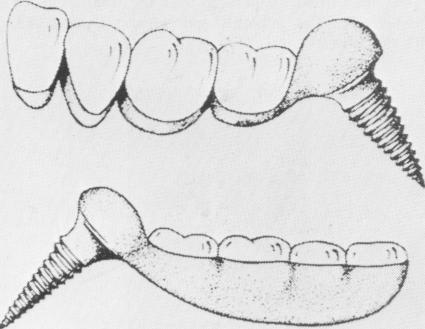
An early implant designed by Dag is an interesting attempt to use what is basically an orthopedic type screw as a dental implant (Fig. 5-11) . Although such a screw might be successful embedded in a bone
*Ibid. 1 Ibid.
$Strock, A. E.: Personal communication.
A B
C D
Fig. 5-10. A to C, In 1938 an upper left lateral tooth was replaced by an implant inserted by the Strocks. D, Taken in 1951, shows the implant still in place. (Courtesy A. E. Struck.)
Fig. 5-11. Dag's implant was a variation of an orthopedic screw. As a dental implant, Dag's design has several flaws. Its impact area is too large, there is no provision for drain-age, and the threads are much too close together. (Courtesy Dag.)
|
Previous Page
|
Page 143 |
Next Page
|
|
Copyright warning: This information is presented here for free for anyone to study online. We own exclusive internet copyrights on all content presented on this website. We use sophisticated technology to identify and legally close down websites that reproduce copyrighted content without permission - so please don’t do it.
|