| Theories and Techniques of Oral Implantology (vol.1) (published 1970) | Dr. Leonard I. Linkow |
 Previous Page Previous Page
|
Next Page 
|
| This is an archival HTML version of this book originally hosted here in 2006. The HTML may not display well on modern browsers. Please view the modern PDF Version for a better viewing experience. |
152 Theories and techniques of oral implantology
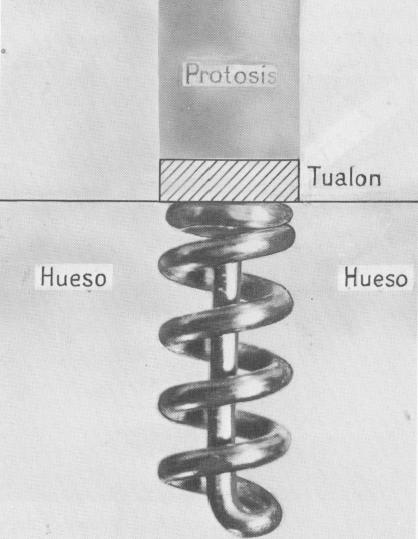
Fig. 5-31. Experimentally, Perron-Andres included an Ivalon (Tualon) casing around the shaft. The substance irritated the tissues and induced bone resorption, in addition to in-creasing the impact area.
works. These helped prove the safety and efficiency of a Formiggini type implant.
The Spaniard Perron-Andres also did a great deal of work with the basic Formiggini design. His approach was very similar to that of Formiggini: that is, he continued to twist the wire back upon itself to form a series of spirals. However, he fused his spiraled part to a cast solid shaft (Fig. 5-30).
In response to criticism that soft tissues would not adhere closely enough to an implant post to prevent bacterial invasion of the site, Perron-Andres also tried including an Ivalon casing around the shaft of his implant (Fig. 5-31). Ivalon, a polyvinyl sponge, supposedly would stimulate soft tissue growth around the post. However, bacteria flourishes in Ivalon and infection spread from the sponge to the soft tissues around it. Perron-Andres abandoned this feature after numerous failures. Evidence that soft tissues would closely condense around implant abutment posts was gained through his own work as well as that of others with all-metal implants.
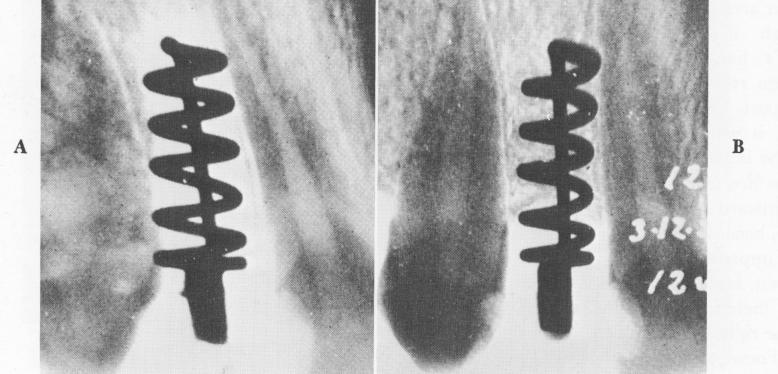
Perron-Andres experienced partial success with his all-metal implant (Fig. 5-32). However, as can be clearly seen in the x-rays, the design of his implant permitted the invagination of soft tissues around the first few spires. Following Formiggini's concept that it was the number of spirals, not the
Fig. 5-32. A, A partially successful Perron-Andres implant just after insertion. B, Bone has clearly grown around and through most of the spirals. However, the superficial spires are surrounded by soft tissues. (From Chercheve, R.: Les implants endo-osseoux, Paris, 1962, Librairie Maloine.)
|
Previous Page
|
Page 152 |
Next Page
|
|
Copyright warning: This information is presented here for free for anyone to study online. We own exclusive internet copyrights on all content presented on this website. We use sophisticated technology to identify and legally close down websites that reproduce copyrighted content without permission - so please don’t do it.
|