| Theories and Techniques of Oral Implantology (vol.1) (published 1970) | Dr. Leonard I. Linkow |
 Previous Page Previous Page
|
Next Page 
|
| This is an archival HTML version of this book originally hosted here in 2006. The HTML may not display well on modern browsers. Please view the modern PDF Version for a better viewing experience. |
The evolution of dental implants 161
that an implant not in immediate function, no matter how ingenious its design, fails.
The "sleep-away" implant of Raphael Chercheve, conceived in 1958, consisted of a hollow screw with internal threading that was to be set near the alveolar crest (Fig. 5-51). When the site had healed, the implant was reexposed and a screw bearing a prosthesis was inserted through the oral mucosa (Fig. 5-52). The uppermost shaft had eight sides in order to reduce trauma to the site. This type of "sleep-away" implant had limited success, and the technique has been discarded.
Another Chercheve variation of the same idea, also currently out of use, is shown in Fig. 5-53. Here the implant was a hollow spring through which it was hoped bone would grow. However, the subsequent insertion of the prosthesis-bearing part of the implant resulted in a great deal of damage to the site, more probably than if a one-step implant procedure had been used in the first place.
The tubular implant of L. Benaim, proposed in
Fig. 5-53. The buried spring implant of Raphael Chercheve. Once bone had grown around the spires, the site was re-opened and a prosthesis-bearing shaft inserted—with a great deal of unnecessary damage. (From Chercheve, R.: Les implants endo-osseoux, Paris, 1962, Librairie Maloine.)
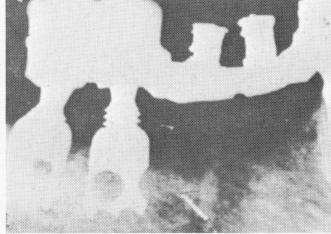
1959, consisted of a hollow perforated cylinder of stellite, open at the lower end and closed at the upper end by an internally threaded screw (Fig. 5-54). To insert the implant, a hollow trephine prepared a circular cut in the alveolar crest. The implant was slipped over the remaining core of bone and the mucosa closed over the implant. About 3 weeks later, the implant was reexposed and a post for a prosthesis inserted. Although the method was somewhat ingenious, the technique invited complications, and the implant was never widely used.
Unlike metallic pins or posts used elsewhere in the body, all dental implants no matter of what design—sooner or later come into contact with the external medium. It is erroneous to think that delaying connecting a buried implant with the prostheses provides any safeguard against external microbial infiltration. The seriousness of an infection is not necessarily proportional to the size of the path permitting bacterial invasion. On the other hand, a larger path-way does help drain a site if it does become infected. It is therefore unwise to eliminate communication between a buried implant and the oral cavity. It is also important to use an implant design that encourages drainage from the onset of its insertion. The healing around the implant will then occur uneventfully.
Block implants
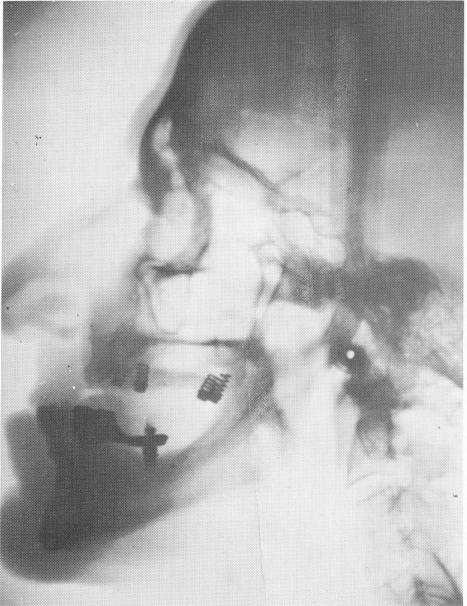
Only a few block implants have been done and the idea has been discarded by its designer, Raphael Chercheve, in favor of more practical and successful approaches. This system, proposed in 1955, involved embedding an acrylic block in bone beyond the apices of teeth in the anterior region of the maxillae or mandible (Fig. 5-55). Then props or pins were driven through the canals of the teeth and
Fig. 5-54. Benaim's tubular implant was set over a core of bone and the mucosa temporarily closed over the implant. The implant was then reexposed and a prosthesis-bearing post inserted.
|
Previous Page
|
Page 161 |
Next Page
|
|
Copyright warning: This information is presented here for free for anyone to study online. We own exclusive internet copyrights on all content presented on this website. We use sophisticated technology to identify and legally close down websites that reproduce copyrighted content without permission - so please don’t do it.
|