| Theories and Techniques of Oral Implantology (vol.1) (published 1970) | Dr. Leonard I. Linkow |
 Previous Page Previous Page
|
Next Page 
|
| This is an archival HTML version of this book originally hosted here in 2006. The HTML may not display well on modern browsers. Please view the modern PDF Version for a better viewing experience. |
Operative tips 283
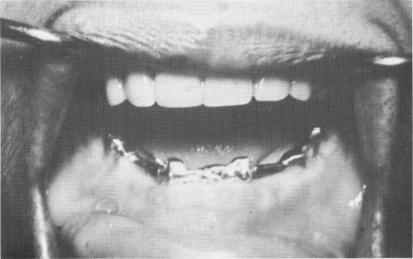
and neck of the implant, such as is characteristic of blades and subperiosteal implants, should be filled with an appropriate wax or with acrylic resin prior to cold-curing the temporary acrylic splint in the mouth (Fig. 7-61).
The alginate impression with the cold-curing acrylic resin should never be left in the mouth to harden or it could pull out the implants upon its removal. It should be removed while still soft and immersed in hot water. When it hardens, it should be carefully trimmed. The interior of the acrylic crowns are further enlarged so that the splint will fit passively over the teeth and implants.
No cement of any sort should be placed inside those crowns to cover the implants. Temporary cement can be used for all other crowns. Vaseline or an antibiotic salve can be used inside the implant crowns.
Copings
The copings for screw type implants, which have square shafts, should be cast in gold and made to fit rather loosely. The looseness is essential, because if the nontapered implant posts are not exactly par-
Fig. 7-64. Soft copings soldered to a connecting bar. (Courtesy I. Lew.)
allel, the implants can be dislodged trying to angle the plaster index to slip off the copings. The outer surface of the copings may be smooth or, better, irregular in order for it to adhere firmly to a plaster pick-up impression (Fig. 7-62). Some operators keep on hand a soft gold strip that can be bent and molded over the implant shaft and then soldered (Fig. 7-63).
Sometimes the copings are not soldered but simply fitted over the posts and immediately picked up with a plaster index. Then they are soldered to each other with a connecting bar (Fig. 7-64).
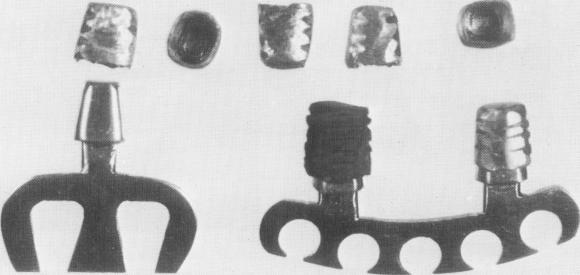
The copings for the posts of blade implants can be cast to fit more snugly because the posts are slightly tapered and rounded (Fig. 7-65).
Plastic copings can also be used. The wax-up of the teeth can be done directly over the plastic copings and then cast in gold, or the plastic copings can be used merely as transfer copings.
Transfer devices
Duplicate posts, shaft dies, or the actual implants themselves should be placed inside the copings for pouring the master stone cast (Fig. 7-66). When the cast hardens, it is separated from the plaster index, and new wax-ups are made directly over the transfer device.
Cementation
The cements used in conjunction with implants and their various superstructures are of prime concern.
Temporary cements. Temporary cements should never be used for final cementation. There is a tendency for the cement seals to separate from the tapered natural tooth abutments long before they do from the less tapered implant posts. Therefore the
Fig. 7-65. Various blades and their copings.
|
Previous Page
|
Page 283 |
Next Page
|
|
Copyright warning: This information is presented here for free for anyone to study online. We own exclusive internet copyrights on all content presented on this website. We use sophisticated technology to identify and legally close down websites that reproduce copyrighted content without permission - so please don’t do it.
|