| Theories and Techniques of Oral Implantology (vol.1) (published 1970) | Dr. Leonard I. Linkow |
 Previous Page Previous Page
|
Next Page 
|
| This is an archival HTML version of this book originally hosted here in 2006. The HTML may not display well on modern browsers. Please view the modern PDF Version for a better viewing experience. |
Operative tips 285
and the holes enlarged slightly so that the bridge can fit passively over the nonparallel implants. One of the hard cements is then used for final cementation.
Removable appliances
When a removable rather than a fixed denture is preferred, the implantologist must devise a means of stabilizing the implants and a way of constructing the prosthesis so that its removal does
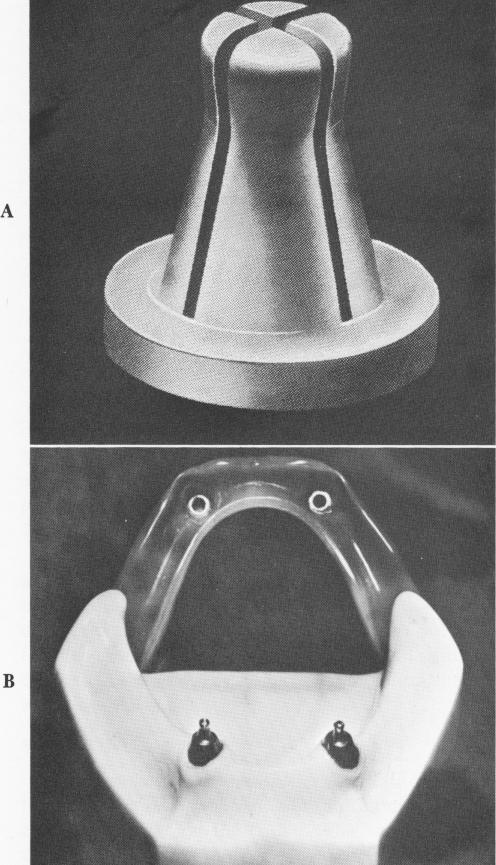
Fig. 7-68. A Ceka attachment. A, The attachment; B, its utilization in the mandible. (Courtesy M. Teilemans Company.)
not disturb the implants. A removable appliance must not be constructed on implants that are isolated from one another. The implants must be splinted to each other either with some form of connecting bar soldered to copings cemented over the implants or with a horizontal or vertical template.
The attachments may be rigid or resilient. The rigid attachments are used primarily for affixing the appliance to the teeth or implants. Several types are quite popular, including internal clip bar attachments, Gerber solid attachments (Fig. 7-67), and Ceka attachments (Fig. 7-68). As the term "rigid" implies, none of these is movable. They are used primarily for abutment supported cases and removable bridgework.
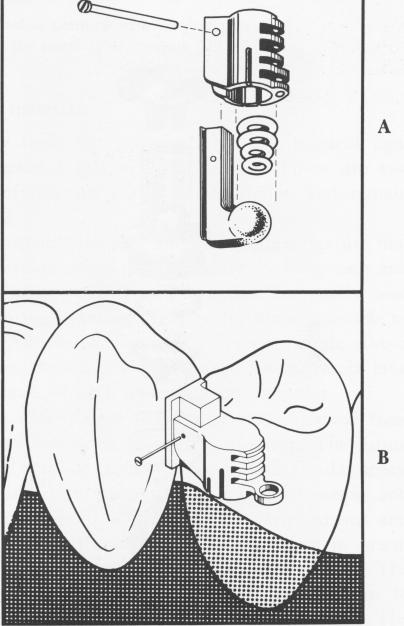
The resilient attachments are used for retentive purposes and as distal extension stress-breakers. The two most popular attachments are the Dalbo and Crismani designs. The Dalbo attachments have vertical resilience, hinge action, lateral stability, and a
I I _
Fig. 7-69. The Dalbo attachment. A, An exploded view; B, its use as a posterior stress-breaking attachment. (Courtesy American Precision Metals.)
|
Previous Page
|
Page 285 |
Next Page
|
|
Copyright warning: This information is presented here for free for anyone to study online. We own exclusive internet copyrights on all content presented on this website. We use sophisticated technology to identify and legally close down websites that reproduce copyrighted content without permission - so please don’t do it.
|