| Theories and Techniques of Oral Implantology (vol.1) (published 1970) | Dr. Leonard I. Linkow |
 Previous Page Previous Page
|
Next Page 
|
| This is an archival HTML version of this book originally hosted here in 2006. The HTML may not display well on modern browsers. Please view the modern PDF Version for a better viewing experience. |
Operative tips 303
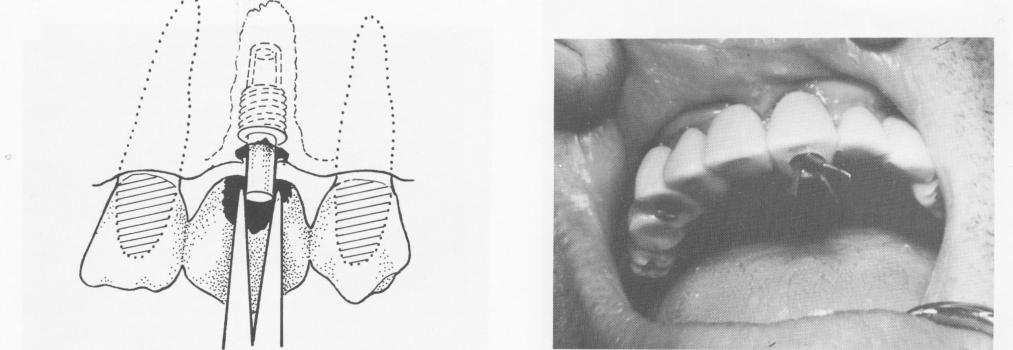
Fig. 7-88. A three-unit fixed restoration may be saved by sacrificing the labial part of the gingival labial surface of the implant crown in order to obtain a good grip on the implant post with a narrow-necked pliers. When the implant has been removed, the crown is filled with an esthetic filling material and reshaped.
Fig. 7-89. In order to maintain some of the stability of a fixed partial denture that has been lost by the removal of a post type implant, pin implants can be drilled through the crown itself.
may be prepared as the abutment for the fixed bridge (Fig. 7-87).
If the failing implant is between two natural teeth and must be removed without destroying the bridge, then a fissure bur is used in a contra-angle to sever the implant from its crown at the gum line. The implant is then pulled out through the buccal or labial plate of bone, using a narrow-necked pliers (Fig. 7-88). If there is too much resistance, some of the bone near the alveolar crest on the facial side may have to be removed, or it may be sufficient when the bone is very thin to simply reflect the soft tissues. In such cases a suture or two may be required.
If removing an implant through bone endangers the neighboring teeth by contributing to their mobility, pin implants should be driven through the crown formerly covering the implant and into the bone to ensure its stability. To do this, a wide funnel-shaped hole is made with a fissure bur in the occlusal or incisal surface of the crown. Three pin implants are then drilled and tapped through the funnel in three directions into the bone (Fig. 7-89) . Their ends are cut off so that the pins do not protrude beyond the hole. Using a paintbrush and acrylic liquid and powder, the ends are fastened together and the en-tire funnel is filled densely with the resin material. If some of the facial portion of the gingival tissue recedes in the area where the implant was removed, the gingival tissue–bearing surface of the pontic may
be lengthened with appropriately tinted resin material.
When two screw type implants are acting as the posterior abutments for a fixed partial denture and the more menial implant must be removed, similar procedures can be used to avoid sacrificing the pros-thesis. The buccogingival third of the crown covering the failing implant is removed with a No. 4 or No. 6 round bur until the entire shaft of the implant can be seen (Fig. 7-90). The implant is removed buccally with a narrow-necked pliers. A few weeks later the buccogingival third of the molar pontic is restored with quick cure resin material.
Failing triplants
Of all implant types, pin implants are easiest to remove because neither bone nor connective tissue can gain a firm hold on their smooth sides. Most of the time, once the crowns cemented to them are severed from the rest of the bridge (Fig. 7-91), the entire tripod can be extracted by merely pulling in a vertical direction away from the bone. The pins, while still attached to the acrylic core and even though splayed in various directions, will come out together with no distortion (Fig. 7-92). The pontic or crown nearest the edentulous area then should be prepared for a full crown restoration. In this case, the original prosthesis consisted of a full arch fixed denture where the last natural abutment was the left central incisor tooth. Therefore the right
|
Previous Page
|
Page 303 |
Next Page
|
|
Copyright warning: This information is presented here for free for anyone to study online. We own exclusive internet copyrights on all content presented on this website. We use sophisticated technology to identify and legally close down websites that reproduce copyrighted content without permission - so please don’t do it.
|