| Theories and Techniques of Oral Implantology (vol.1) (published 1970) | Dr. Leonard I. Linkow |
 Previous Page Previous Page
|
Next Page 
|
| This is an archival HTML version of this book originally hosted here in 2006. The HTML may not display well on modern browsers. Please view the modern PDF Version for a better viewing experience. |
Single tooth implants 313
After a few cases have been presented, comparative conclusions will be drawn.
Case 1
A totally unsupported implant
On the first visit, a rubber base or alginate impression and a wax interocclusal record of centric relation were taken of the edentulous area, including at least one or two teeth on either side. Then a du-plicate implant shaft about 5 mm. long was centered in the edentulous ridge of the stone model, halfway between both neighboring teeth. In order to help stabilize the implant shaft in the stone model, a square hole the size of the periphery of the shaft was made about 3 mm. deep in the stone. Sticky wax could also have been used to help stabilize the shaft. About three coats of nailpolish or lacquer were then painted on the protruding shaft to make it larger on all four sides (Fig. 8-1). Enlarging helps facilitate any adjustments needed to fit the crown restoration over the implant after it has been set in bone.
Using the stone model with the enlarged post, the full crown restoration was waxed, cast, and processed (Fig. 8-2). Gold copings with complete acrylic coverage are preferable for single tooth implants, and so one was used.
On the second visit, the crown was tried in the patient's mouth before inserting the implant to see that it fit snugly interproximally (Fig. 8-3). Adjustments for occlusion were made. The crown being satisfactory, a wet indelible pencil was then used on the crown's gingival peripheral margin. The crown was replaced over the edentulous area to transfer the pencil marks onto the fibromucosal tissue. These marks served as a guide for centering and setting the implant in bone (Fig. 8-4). The implant's protruding shaft was measured to ensure that no more than 3 or 4 mm. extended out of the soft tissue into the oral cavity (Fig. 8-5).
The prefabricated full crown restoration was seated over the implant shaft, and the restoration was then checked for fit. Normally there should be little impingement, if any. If the crown does not fit exactly as it did before the implant insertion, a number of procedures may be followed to get a proper fit.
-
The implant shaft may be too long. It can be shortened or the inside of the crown can be made larger and deeper to accommodate it.
-
The shaft may not be accurately centered in the crown. Again, the crown may be modified to receive it.
-
Some of the interproximal surfaces of the crown may have to be disked away.
When the crown was properly seated, cold cure acrylic was used to make the altered lumen more accurately fit the protruding post. Otherwise, once a crown with a greatly enlarged lumen is cemented in-to place, the chances are good that the cement will wash away. Before the acrylic completely set, the crown was removed and allowed to harden outside the mouth. The excess acrylic was removed from the tissue-bearing surface of the restoration and the area polished.
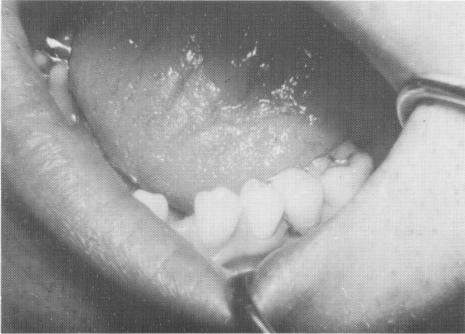
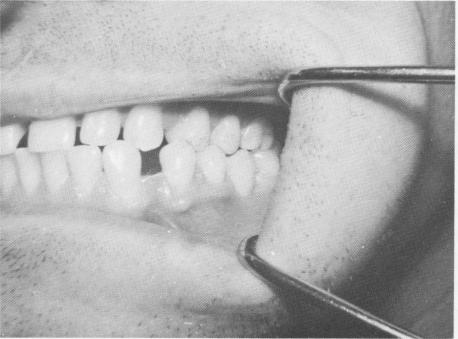
Oxyphosphate of zinc cement was mixed and placed inside the crown, which was replaced over the shaft to harden (Fig. 8-6). After the restoration was cemented into place, it was once again checked for proper occlusion (Fig. 8-7). It is absolutely imperative in single tooth implant interventions to be
Fig. 8-6. The acrylic-and-gold restoration is cemented over the implant shaft with hard cement.
Fig. 8-7. A carefully balanced occlusion is essential.
|
Previous Page
|
Page 313 |
Next Page
|
|
Copyright warning: This information is presented here for free for anyone to study online. We own exclusive internet copyrights on all content presented on this website. We use sophisticated technology to identify and legally close down websites that reproduce copyrighted content without permission - so please don’t do it.
|