| Mandibular Implants (published 1977) | Dr. Leonard I. Linkow |
 Previous Page Previous Page
|
Next Page 
|
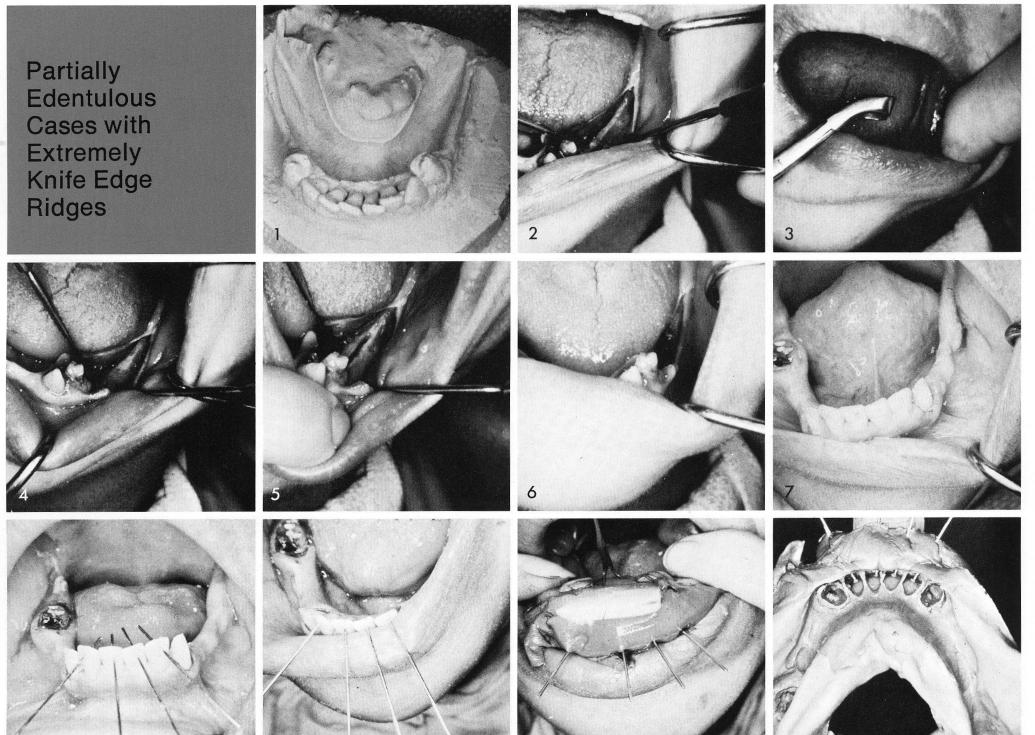
In an extremely knife edge ridge, figs. 1, 2, it is imperative that before a blade can be contemplated, it must be interpreted whether or not the occlusal table can be made wide enough to accept a groove, by reducing the fragile crestal bone. Either with a bone rongeur, fig. 3, round stone, or bur, or all three, the ridge is reduced and widened, fig. 4, and the groove is made, fig. 5, and the implant is accepted, fig. 6.
Fig. 7 shows a knife edge ridge on the left posterior quadrant. Holes were drilled horizontally above the pulp horns through the four incisor teeth and pins were placed through them, fig. 8. They were then backed up to fit flush with the lingual surfaces of the incisor teeth, fig. 9, to facilitate the impression technique, fig. 10, allowing the impression to be removed without tearing or distorting, fig. 11. The necessary lingual castings were fashioned to fit over the prepared lingual surfaces of the incisors and full crown coverage restorations were cast for the remaining cuspids and right molar, fig. 12.
246
|
Previous Page
|
Page 246 |
Next Page
|
|
Copyright warning: This information is presented here for free for anyone to study online. We own exclusive internet copyrights on all content presented on this website. We use sophisticated technology to identify and legally close down websites that reproduce copyrighted content without permission - so please don’t do it.
|