| Theories and Techniques of Oral Implantology (vol.2) (published 1970) | Dr. Leonard I. Linkow |
 Previous Page Previous Page
|
Next Page 
|
| This is an archival HTML version of this book originally hosted here in 2006. The HTML may not display well on modern browsers. Please view the modern PDF Version for a better viewing experience. |
Endosseous blade implants 507
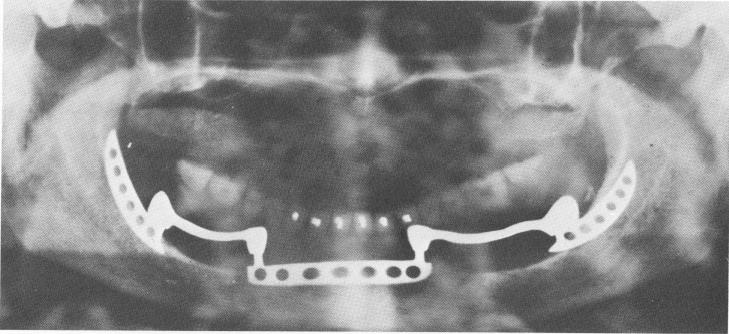
cording to Dr. Harold Roberts, there still remains serviceable bone in the retromolar area and in the ramus. Thus Roberts developed the retromolar blade implant (Fig. 11-147) .
The retromolar blade implant is placed into the bone by first making a long incision along the fibromucosal tissue covering the alveolar crest. The mesial limit of the incision is approximately 28 mm. distal to the mental foramen and extends distally approximately 18 mm. A groove is cut with a No. 560 bur immediately below the incision into the cortical bone, extending distally approximately 14 to 18 mm. to the entire depth of the bur (5.5 mm.) . The distal end of the sickle-shaped implant is then inserted into the slot in the bone below the cortical plate and is tapped distally into the medullary portion of the ramus between the buccal and lingual cortical plates until the mesial lip of the blade portion of the implant clears the anterior margin of the bony slot. Since the inferior surface of the implant is rounded, it slips gently into place posteriorly into the ascending ramus. A grooved chisel and plastic-headed mallet are all that is necessary for this procedure. With a crown and bridge remover locked be-hind the distal proximal surface of the protruding post, the implant is gently tapped menially so that the mesial spur of the implant locks under the cortical plate that forms the anterior limit of the bony slot. The flaps of the soft tissue are repositioned and sutured around the protruding post. The sutures are removed in 5 to 7 days.
An impression is taken of all the protruding posts for a one-piece gold coping–dolder bar framework that is cemented into position. A removable prosthesis is then fabricated to fit over the gold framework, with
or without the addition of retentive type attachments.
THE EDENTULOUS MAXILLA
Fixed restorations for the edentulous maxilla have posed a major problem in the field of implantology. Because the maxillary alveolar bone usually resorbs in a buccopalatal direction, ultimately leaving a knife-edge ridge, post and triplant implants are often unsuitable or inadequate. Perforation is common, and the danger of destroying a good portion of the alveolar crest is a real threat. In addition, because extremely thick fibromucosal tissue often camouflages a thin ridge, it is usually almost impossible to enter the bone directly at the crest to insert a post type implant. As for tripod pins, there is frequently no room to diverge them, and the thick soft tissue promotes a trifurcation involvement. Obviously, an implant had to be designed specifically for knife-edge ridge conditions. This implant is the blade.
The endosseous blade implants, although functioning in the mouths of patients for approximately 3 years, seem to be extremely encouraging for the edentulous maxillary patient. The following cases illustrate their use.
Case 13
A full arch palateless fixed restoration for a completely edentulous maxilla
Impressions were taken of the edentulous maxilla (Fig. 11-148), including an elastic impression, a bite rim and tray, a lower alginate impression, and a wax bite. At the next visit, the tray was lined with Opotow paste and placed in the patient's mouth. When it hardened, it was trimmed and the wax rim care-
Fig. 11-147. Retromolar blade implant abutments in combination with an anterior blade acting as abutments for a removable prosthesis. (Courtesy Dr. Harold Roberts.)
|
Previous Page
|
Page 507 |
Next Page
|
|
Copyright warning: This information is presented here for free for anyone to study online. We own exclusive internet copyrights on all content presented on this website. We use sophisticated technology to identify and legally close down websites that reproduce copyrighted content without permission - so please don’t do it.
|