| Theories and Techniques of Oral Implantology (vol.2) (published 1970) | Dr. Leonard I. Linkow |
 Previous Page Previous Page
|
Next Page 
|
| This is an archival HTML version of this book originally hosted here in 2006. The HTML may not display well on modern browsers. Please view the modern PDF Version for a better viewing experience. |
Endosseous blade implants 471
done with a screw or pin implant. Because the blade post is smooth and tapered, it is less irritating to the tongue, cheeks, and lips. However, although not essential, it is sometimes better to splint the blade and to place it in immediate function.
12. When the maxillary sinus is too low and too broad, a blade may be tapped into the maxillary tuberosity to act as a posterior abutment. Although this area is very porous, the blade is extremely retentive (Fig. 11-20) .
13. The post of the blade implant provides greater retention for the various types of prostheses. This is because of the larger size and greater length of the blade's post. Also, the head of the post may be manufactured at any angle to the implant's shoulders. This permits seating the blade most advantageously in bone in any direction, yet ensures that the alignment of the post head follows that of the arch of the jaw. Some blades have a post whose head is rotated 180 degrees.
14. The heads of the posts are coordinated in size and shape. This permits using interchangeable
prefabricated gold or plastic copings. Because the posts are also tapered, the copings can be slipped on and off more easily. Compare these features with the nonstandardized acrylic cores built around pins and with the paralleling problems resulting from the small square shaft of any post type implant.
For added retention of the prosthesis, the posts are also manufactured with either vertical or horizontal set screws (Fig. 11-21) .
15. Making the abutment posts parallel with other artificial or natural abutments is easier with the blade. Buccolingual parallelism is very simply achieved by bending the neck before tapping the blade into bone. Mesiodistal parallelism can be achieved by grinding after insertion because the implant is so securely held by bone. In situ grinding of another type of implant is impossible, unless the post can be firmly supported by pliers.
16. The various designs serve specific purposes. For example, when extremely dense alveolar bone is anticipated, a blade whose inferior border is not continuous should be used (Fig. 11-22). Because the
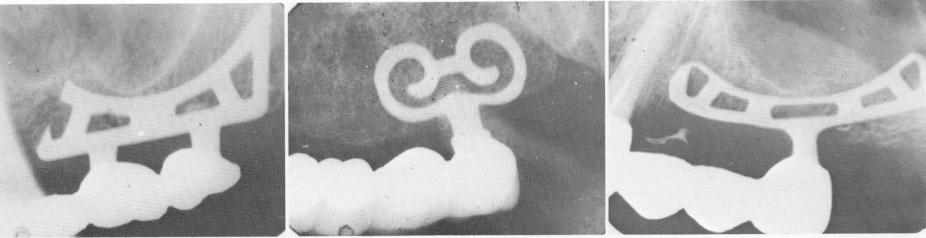
Fig. 11-23. Blades with more secondary struts are used in porous areas.
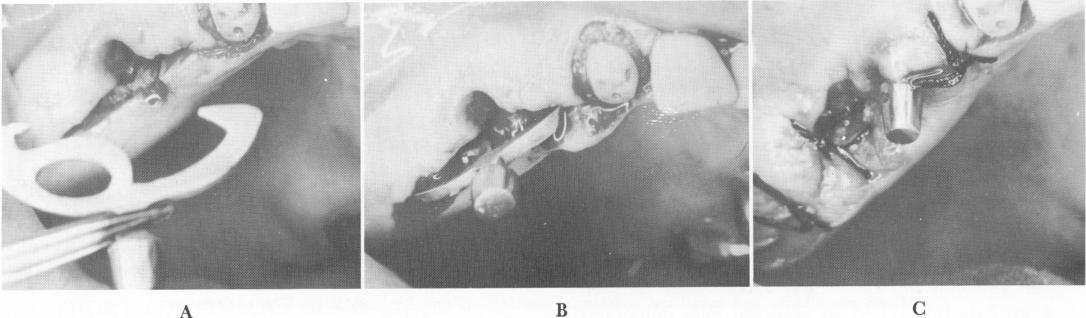
Fig. 11-24. The blade for an open socket. A, The blade extends anteriorly and posteriorly in unaffected bone beyond the socket. B, The blade in the groove. C, The correctly seated blade and tissues sutured over the blade.
|
Previous Page
|
Page 471 |
Next Page
|
|
Copyright warning: This information is presented here for free for anyone to study online. We own exclusive internet copyrights on all content presented on this website. We use sophisticated technology to identify and legally close down websites that reproduce copyrighted content without permission - so please don’t do it.
|