| Theories and Techniques of Oral Implantology (vol.1) (published 1970) | Dr. Leonard I. Linkow |
 Previous Page Previous Page
|
Next Page 
|
| This is an archival HTML version of this book originally hosted here in 2006. The HTML may not display well on modern browsers. Please view the modern PDF Version for a better viewing experience. |
Operative tips 281
cified root canals, or in locating openings in root canals. With special connections attached to the eyepiece of the scanner, photographs can also be taken of a socket.
LABORATORY TIPS
Accurate fabrication of a prosthetic device suit-able to the particular patient's needs plays a major role in the success of an implant-supported restoration. The best-set implants will fail if the restoration is unsuitable or fits poorly. Of the numerous considerations involved in planning dental restorations, the following are particularly important to the implantologist.
Scalloped templates
When fabricating a scalloped template for additional support of pin implants in a completely edentulous or partially edentulous maxilla, never "ditch" the master stone model. The template must fit passively over the mucoperiosteal tissue.
Palatal bars
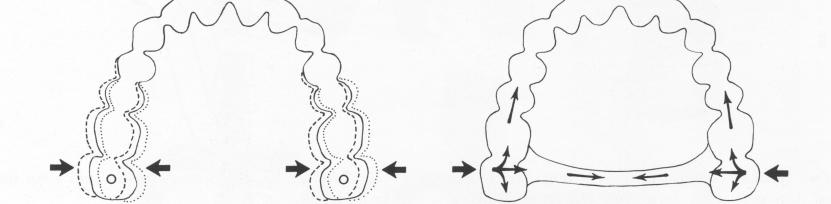
When pin implants and a template are to be used in a completely edentulous maxilla, a posterior palatal bar should be included. The palatal bar helps distribute forces from one side of the template to the other (Fig. 7-60). The palatal bar may be rigidly connected to the template by solder or cast in one piece with the template. It can also be connected to the template by male and female attachments if re-movability is desired.
It is important that the palatal bar fit passively over the most distal portion of the tissues over the hard palate; therefore, the model should never be ditched in this area. The bar should never extend to the soft palate.
Impingement considerations
All full crown and pontic restorations should be implant-borne, not tissue-borne. Therefore no trimming down should ever be made on the master stone model prior to the fabrication of the pontics or crowns that are to be fitted over the implant posts.
Because the buccogingival line angles of lower restorations and the palatogingival line angles of maxillary pontics and crowns may compress the soft tissues, the corresponding line angles of the restorations should be relieved and rounded out prior to insertion.
To avoid excessive "digging" into the mucoperiosteal tissues by a full arch or partial fixed denture, especially in completely edentulous patients, it is best to have the patient wear the prosthesis temporarily for a few days prior to final cementation. All interfering areas should be relieved before final cementation.
Prefabricated restorations
Prefabricated bridges are recommended when using screw type implants and triplants. The same laboratory precautions should be carefully followed; namely, no ditching of the master model, rounding out of all line angles of the restorations, and ensuring that the crowns are implant-borne with the pontics only passively touching the tissues.
Prefabricated prostheses are not necessary with blade implants.
Temporary splints
If temporary acrylic splints are used instead of prefabricated prostheses, several steps are imperative. All tooth preparations, unprepared teeth, and implant posts should be lubricated with Vaseline or cocoa butter. Any undercut areas between the post
Fig. 7-60. A palatal bar reduces some of the torque action and helps stabilize the template by distributing stress.
|
Previous Page
|
Page 281 |
Next Page
|
|
Copyright warning: This information is presented here for free for anyone to study online. We own exclusive internet copyrights on all content presented on this website. We use sophisticated technology to identify and legally close down websites that reproduce copyrighted content without permission - so please don’t do it.
|